Animals in advertising – Primates
Primates come mostly as chimpanzees and gorillas, though we have also a couple of orangutangs, macaques, and baboons.

What we learn about them is elementary: monkeys like to imitate and they are crazy about bananas.

Rarely, if ever, do copywriters succeed in connecting a characteristic of the animal to a feature of the advertised product. Why a primate was chosen is usually a mystery.

© 
first published: vii.2026

Chimpanzees are the monkeys
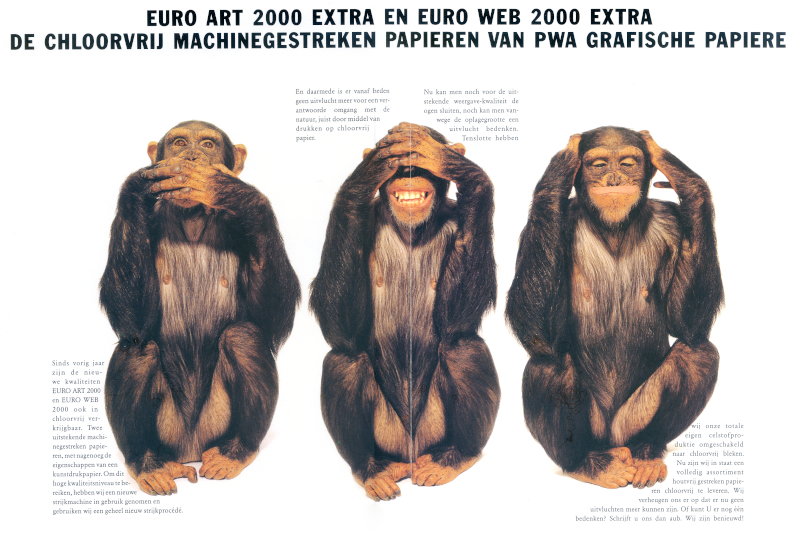
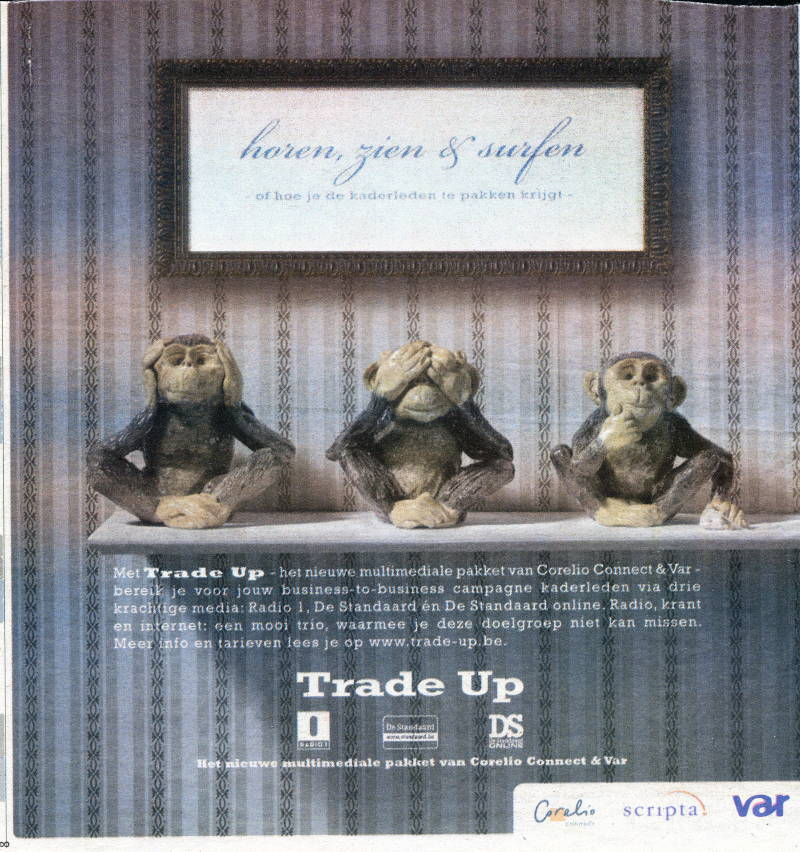
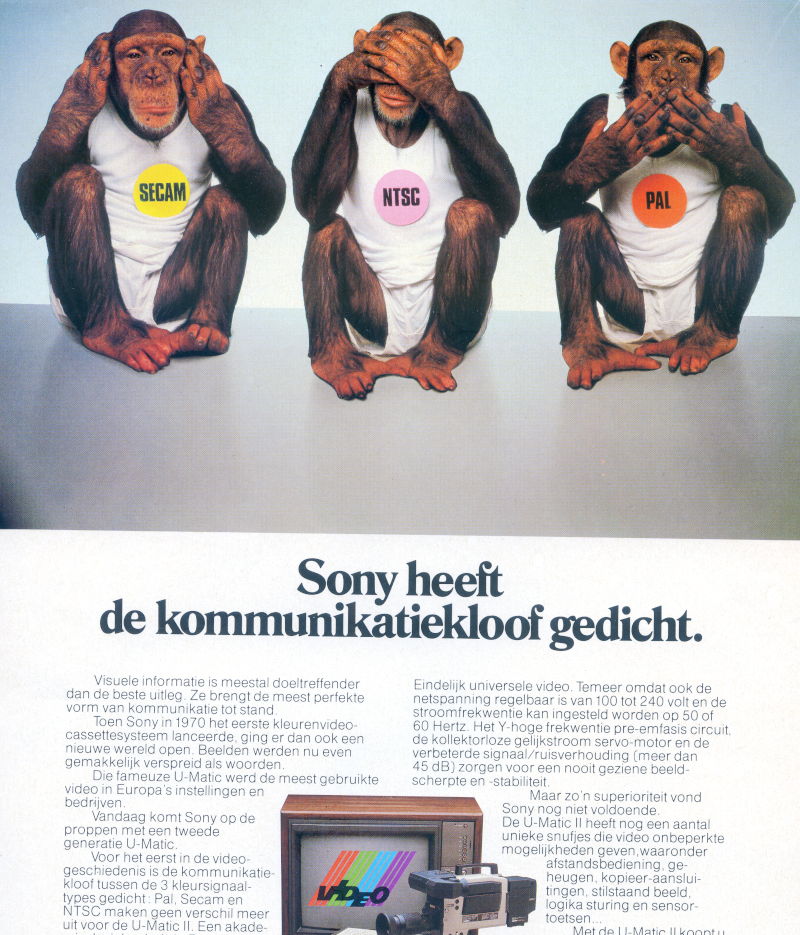
most relied upon to sell a product or service. They are primarily used in a setting of the three wise monkeys who illustrate the proverbial principle of see no evil, hear no evil, speak no evil (№s 1–3), but not necessarily in that order. The pro­verbial, however, no longer plays a role. The trio is used as a kind of bullet list. Each animal can then stand for a characteristic, but even that is not always the case.

(1) 197? – Bridging the communication gap — video system.
(2) 199? – No more excuses — printing paper.

In Bridging the communication Gap
(1) every chimpanzee wears a chest tag with one of the video standards (Secam, NTSC, PAL) supported by this system. Apart from that, nowhere in the text is there any allusion made to any characteristic that the device shares with the animals. Only the number, three, is important.

In No more excuses (2) for chlorine-free paper, the connection with the image is even more difficult to discover. Only the attentive reader will notice the bullet list. Here we go (from Dutch): … from today, there is no longer any excuse for a responsible approach to nature, … nor to turn a blind eye to the excellent reproduction quality … nor can one devise an excuse due to the print run size … Again, only the number three is important.

The same applies to Hearing, seeing & surfing (3) where a package deal is presented for a campaign on radio, in the newspaper, and online. There is a connection with hearing and seeing, that much is true.

(3) 2006 – Hearing, seeing & surfing — multimedia advertising.
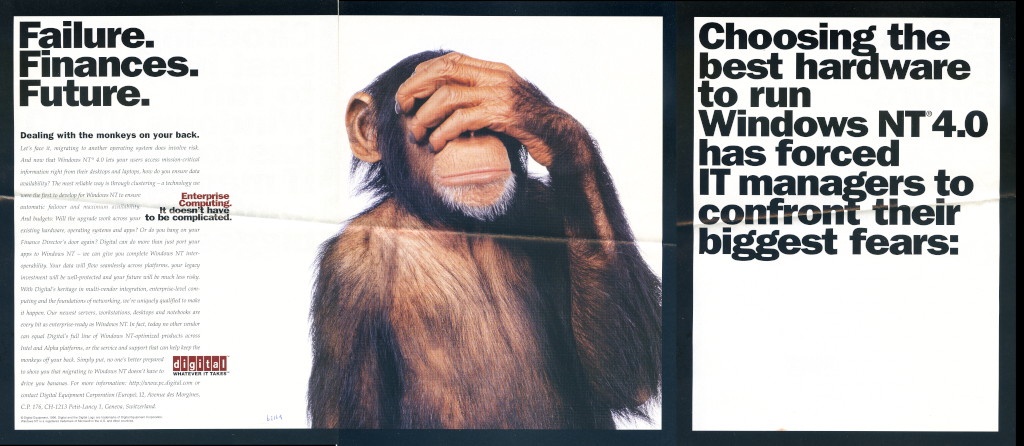
(4) 1996 – Dealing with the monkeys on your back — enterprise computing.

Dealing with the monkeys on your back
(4) alludes to a very famous article published in the Harvard Business Review in 1974. The article warns against a common mistake made by managers who, with the best intentions, take on the solution of a subordinate's problem and thereby risk becoming a bottleneck in the organization. The monkey represents a problem, or the next step in a process, and the manager would do best not to take this (the monkey) upon himself (his back). The message in № 4 is clear: IT managers must entrust the transi­tion to a new operating system (here NT® 4.0) to a competent partner. The monkey here does not stand for a specific characteristic, but simply because an author long ago chose to use monkey as a representation for problem.

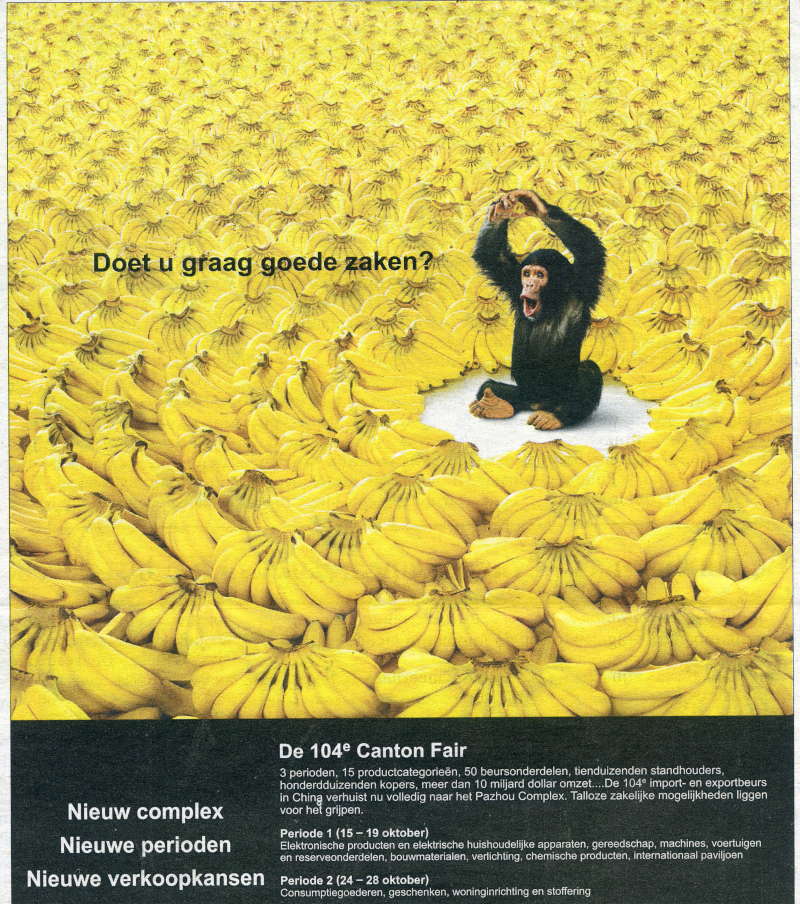
(5) 2008 – Do you like doing good business? — trade fair.
Monkeys are crazy about bananas,
that is a known fact. Example № 5 is part of a series for a trade fair where each time an animal is shown surrounded by an immense amount of its preferred food. Bananas for the monkey (2008), carrots for the rabbit (2008, 2009), flowers for a bee (2011). In this advert you, the reader, are the monkey who is very happy with the numerous possibilities.

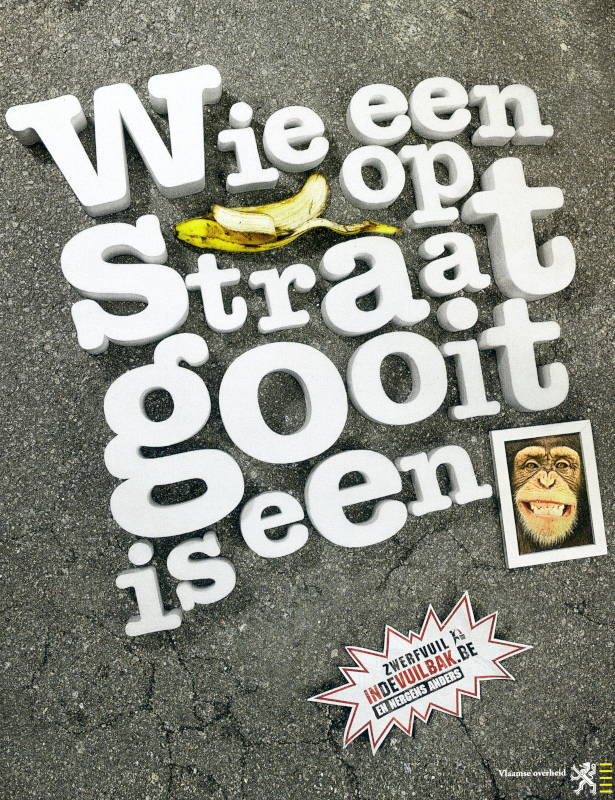
In advert № 6, from a campaign against litter, you are also the monkey, and you are also crazy about bananas. But this time that is not a good thing, because monkey is used here as an insult for you when you throw your banana peel on the street. The banana peel represents litter in general, and since monkeys are crazy about bananas, it is logical that this animal was chosen.

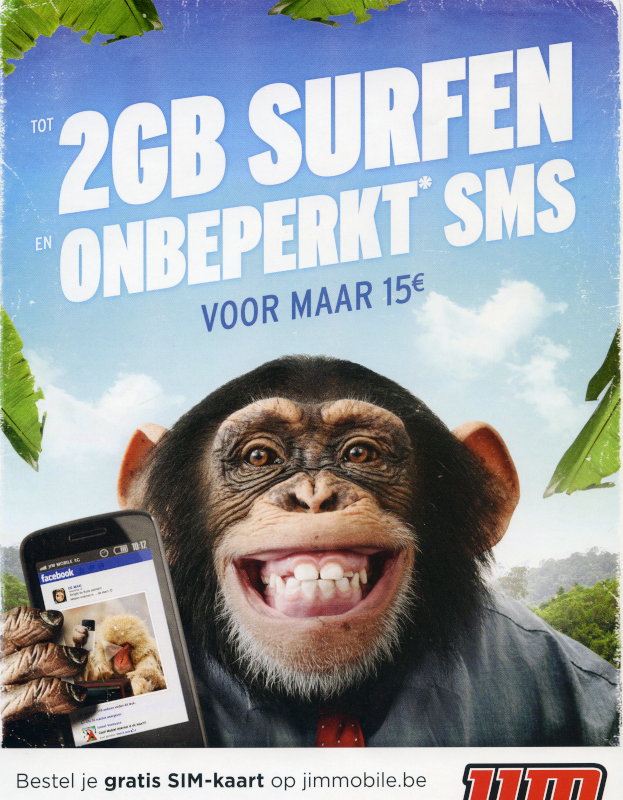
Advert № 7 shows an advert for prepaid mobile internet
. The animal is over the moon with this operator's ultra-low rates. We see a smile from ear to ear. Why a monkey, and not a happy person? It can only be because of that broad smile. But unfortunately what appears to be a smile in this image is known as a fear grimace or a display of aggression rather than a expression of joy.

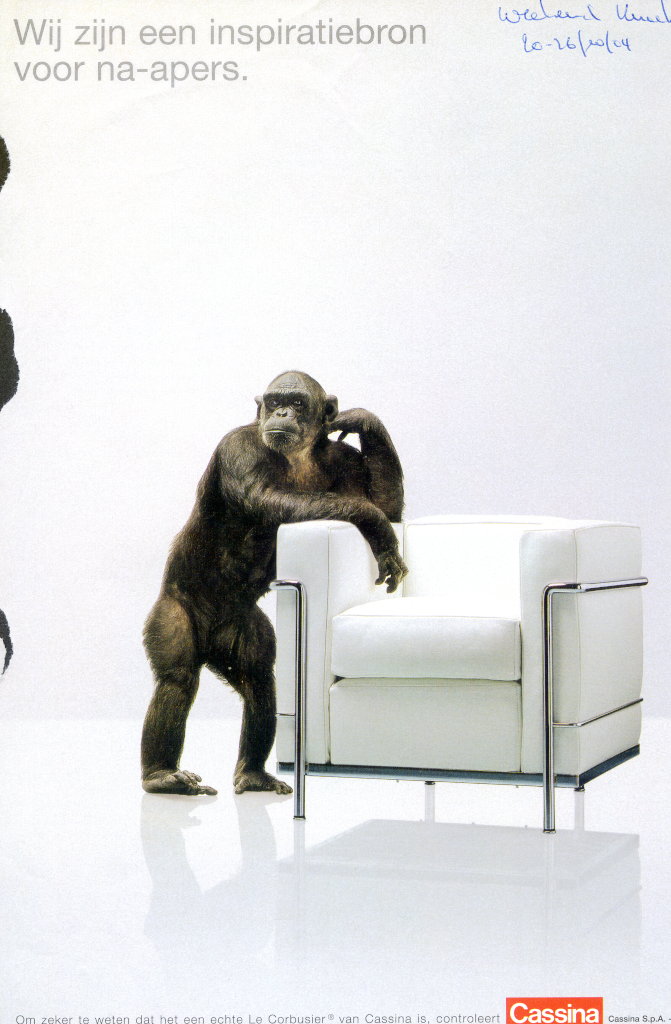
We inspire copycats for designer furniture
(8) is in Dutch and plays with the sound of the verb for to imitate which is na-apen. The verb ends with apen which translates to monkey in English. There is also an expression in Dutch Apen apen apen na which literally means Monkeys imitate monkeys. A play with words and sounds that must be irresistible to copywriters. Otherwise, apart from its imitation behaviour, there is no connection with any characteristic of the animal.

(6) 2009 – Only monkeys throw banana peels on the street. — do not litter.
(7) 2015 – up to 2GB of data and unlimited SMS — mobile internet.
(8) 2004 – We inspire copycats — designer furniture.

Besides chimpanzees, we primarily encounter gorillas
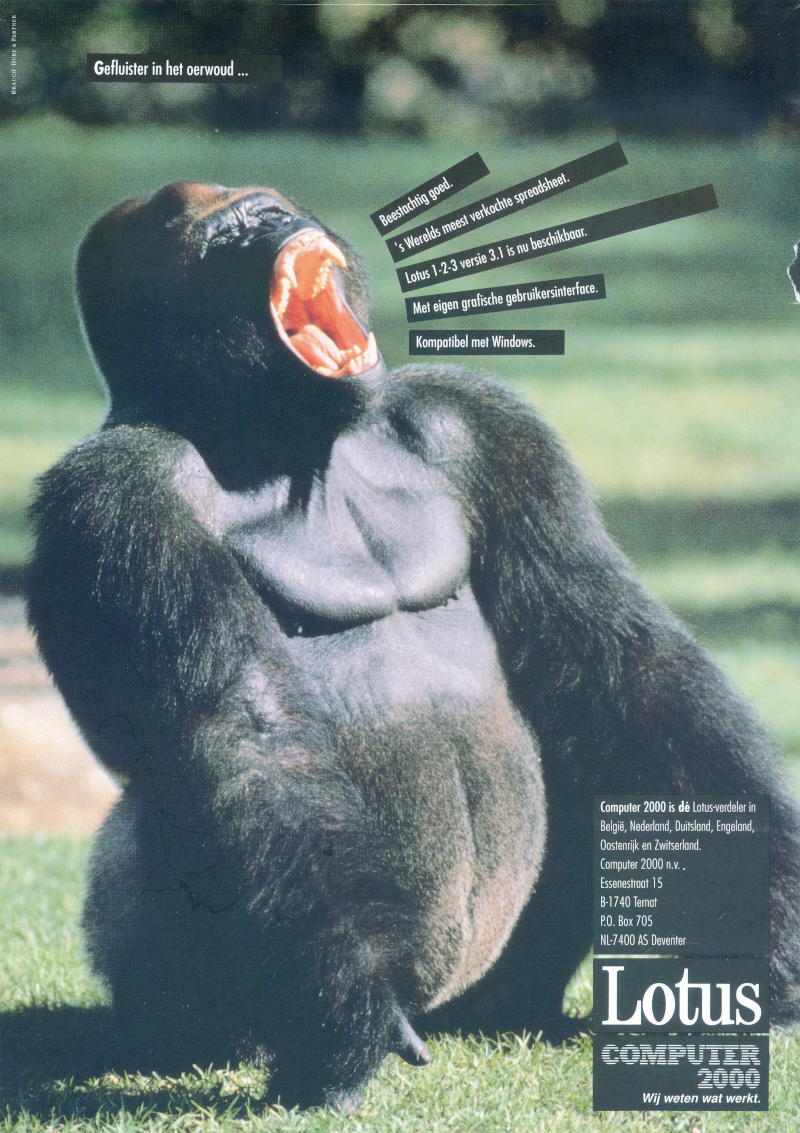
in the advertising landscape. There is no clear sector in which they excel, as we find them in business, pharmaceuticals, printing, and more. In № 9, we see a gorilla roaring (or is it yawning?) and broadcasting important news about Lotus 1-2-3, a spreadsheet program that was state of the art at the time. Let's see if we can learn something about the animal, or the product. The advert is in Dutch, so here comes the translation:
Whispers in the jungle …
Beastly good. • The world's best-selling spreadsheet. • Lotus 1-2-3 version 3.1 is now available. • With its own graphical user interface. • Compatible with Windows.
This text is a source of questions. Why the Whispers? The gorilla's wide-open jaws suggest loud screaming rather than quiet whispering. It cannot be a reference to books with that title either, or a popular computer game. Those all originated much later. Why a Gorilla? None of the textual slogans relates to a characteristic of the animal. The only connection we can imagine is the first exclamation Beastly good, which in the original Dutch means excep­tionally good. Therefore very good > beastly good > beast, animal > let's take a Gorilla. Most unsatisfactory.

(9) 1991 – Whispers in the jungle …
— spreadsheet.
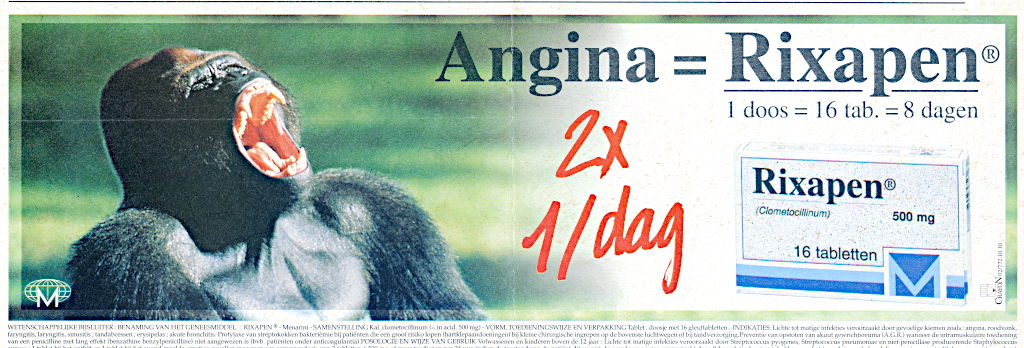
(10) 1995 – Angina = Rixapen ®
— medicine.

The very same Gorilla
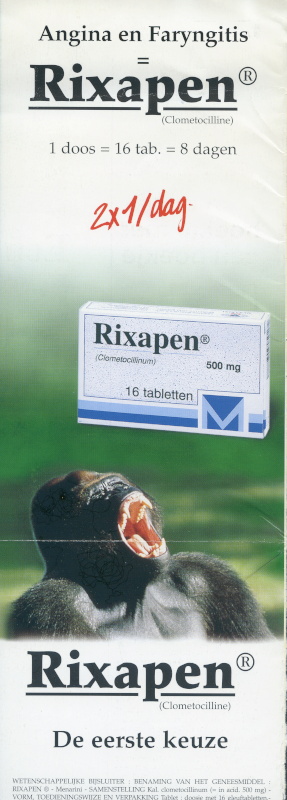
appears again some years later in a advert for antibiotics (10, 11). The product is recommended for throat conditions, and that is perhaps why an animal with a wide-open mouth was chosen. But why exactly a gorilla? The only thing I can think of is that the product name ends in apen, which is the plural of aap (Dutch for monkey ). Since the average writer is probably unaware of the difference between monkeys and apes, a gorilla seems like a suitable choice.

Two brands using the same animal (9 – 11) in their adverts, we have seen it before in the section about bears where there seems to be a shortage in good image material.

(11) 1996 – The first choice
— medicine.
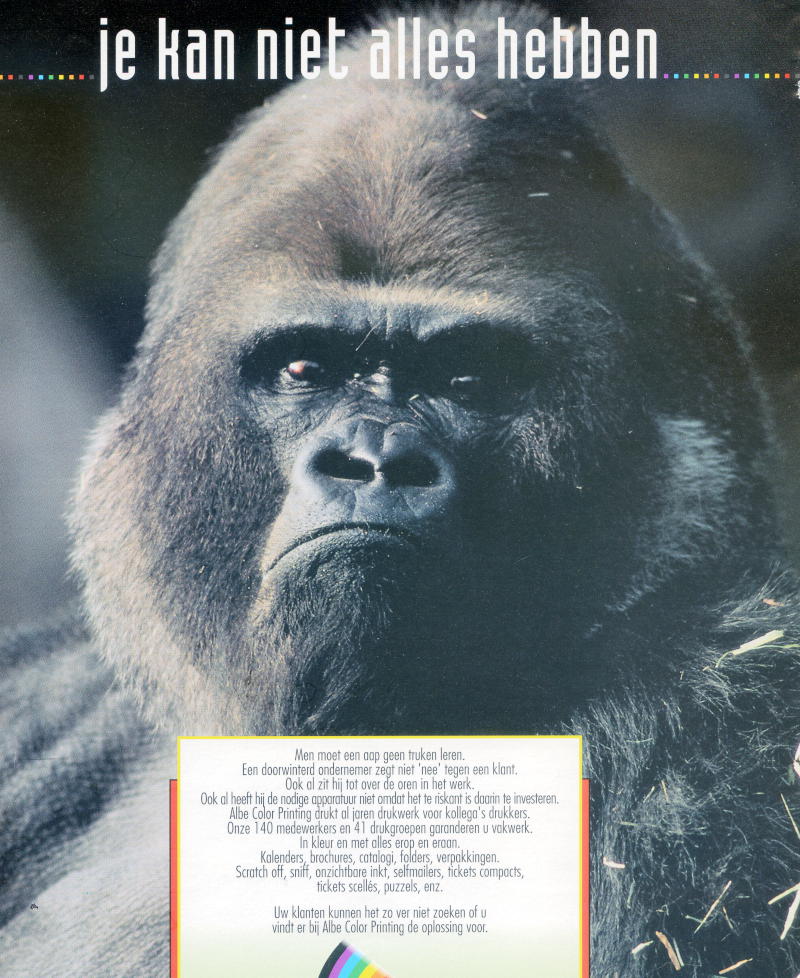
(12) 1993 – You can't have everything. — printing company.
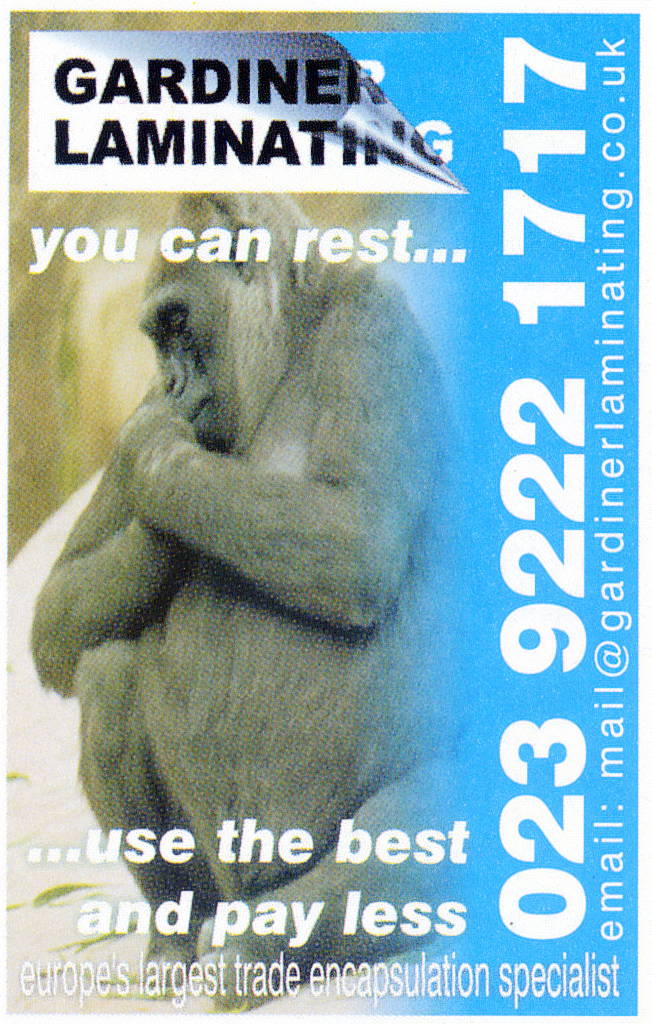
(13) 2000 – Use the best and pay less — laminating service.

In the previous commercials,
we could only guess at the reason for the choice of a gorilla, and the situation does not improve in the other examples (12 – 16).

You can't have everything … (12) continues with You shouldn't teach a monkey tricks. A seasoned entrepreneur does not say no to a customer. … Once again the discrepancy between monkey (text) and ape (image). I can only guess why this animal was chosen. Perhaps analogous to the reasoning with the toad in the section about amphibians?

You can rest and we will make sure everything is taken care of, assures № 13 for the laminating service. But why a gorilla? Because the animal seems to be sleeping? In that case, one could have chosen any sleeping animal. It didn't have to be a gorilla.

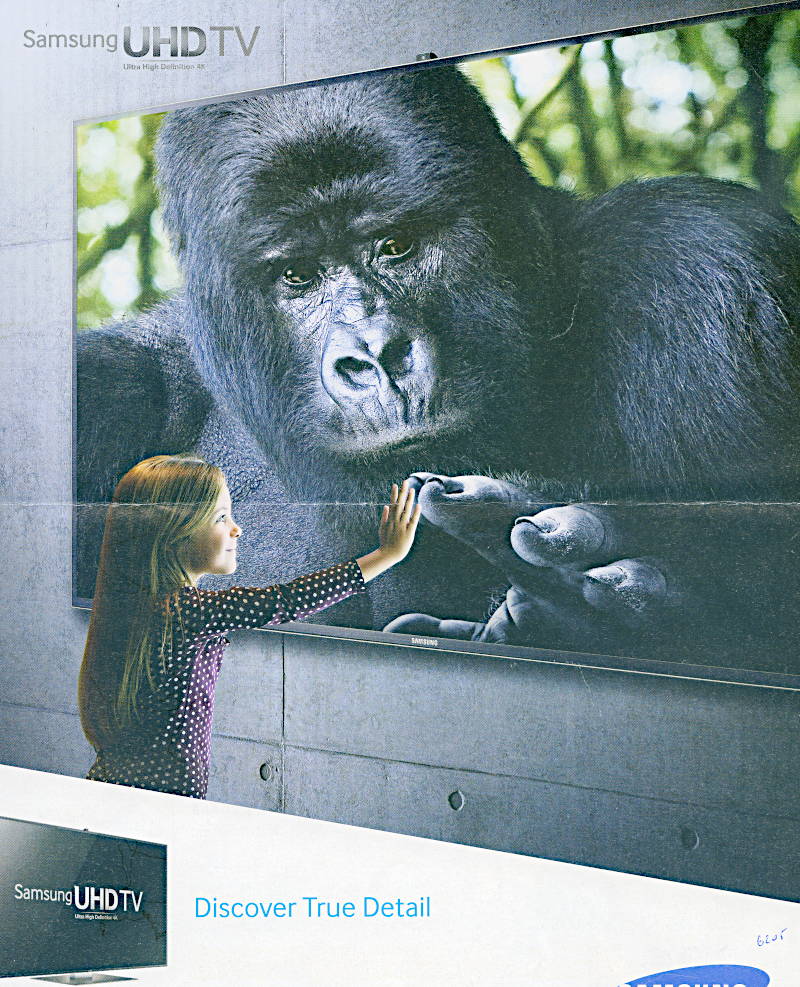
(14) 2013 – Discover true detail — television set
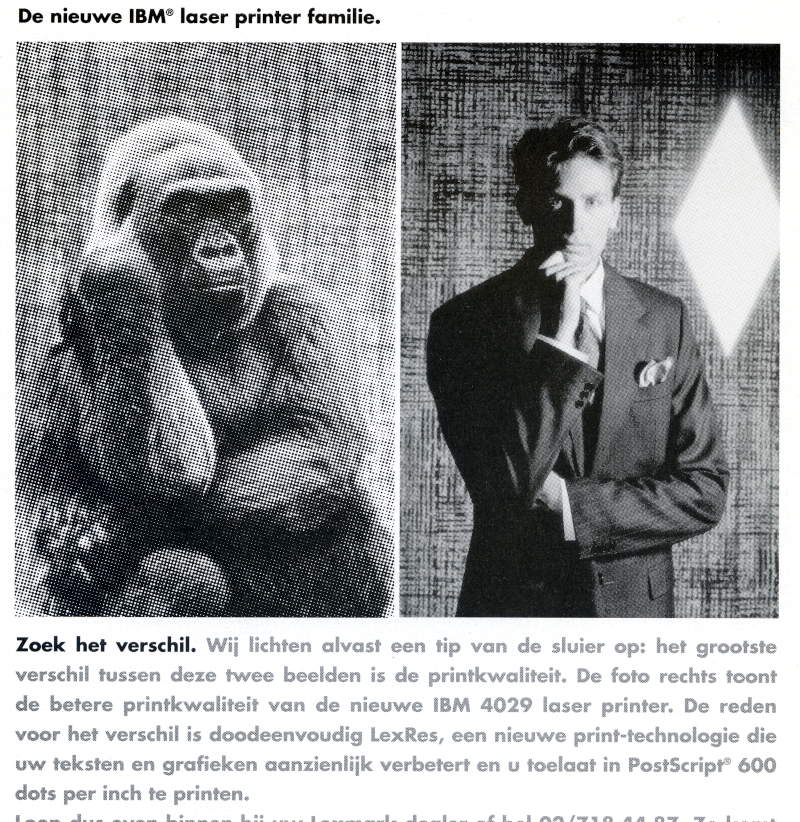
(15) 1991 – Spot the difference — laser printer.

The scene in № 14
was part of a video event which was an opportunity to experience an African safari without the burden of travel to that continent and without disturbing the animals. The videos were shown on the brand's Ultra High Definition screens. Several endangered species were shown, but much attention was focused on the gorillas because they resemble humans so strongly in various aspects. This emotional aspect may explain why the gorilla appears here and not one of the other species.

It is perhaps the same proximity of gorilla and human that explains № 15: The biggest difference between these two images is the print quality …. And it is a bonus that this setting also creates a touch of humor; something often sought after in advertising.

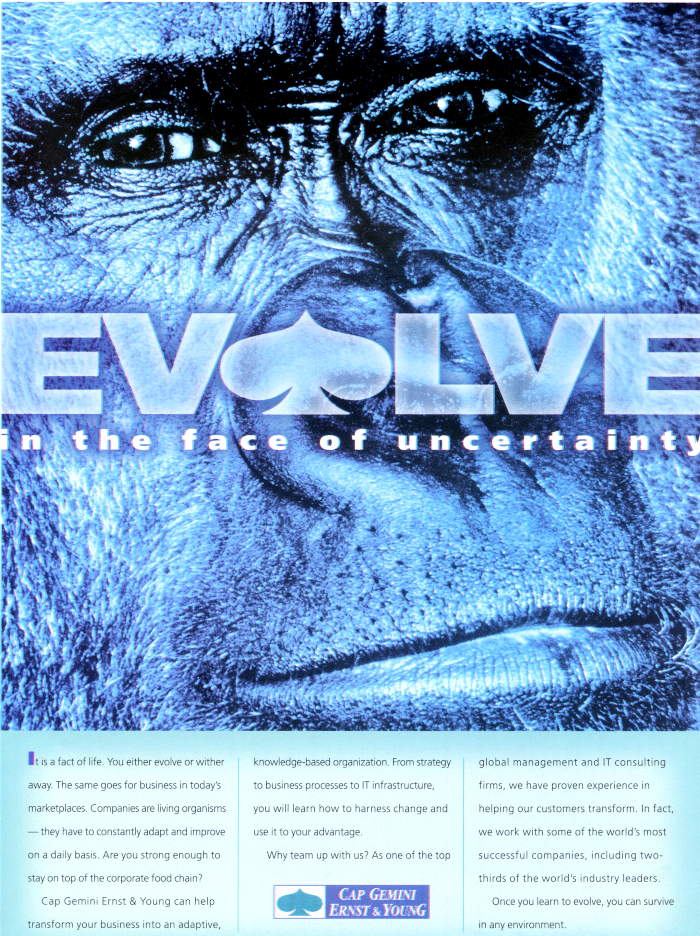
In № 16 Evolve in the face of uncertainty the text goes on with It is a fact of life. You either evolve or wither away. The same goes for business in today's marketplaces … The gorilla must refer to the evolution theory and the one thing that immediately springs to the mind of many people humans descend from apes. But still, why was a gorilla depicted, not a human, or both like in № 15? Does it represent someone who does not evolve? So, is a failure being shown in this advertisement? And whoever calls upon the consulting services then becomes a human? But actually, the gorilla is also a result of evolution. So, successful after all. And what does consulting have to do with evolution? And actually: in the business world, it is not so much about evolution as it is about adaptation, isn't it? Sigh.

(16) 2001 – Evolve in the face of uncertainty — consulting.
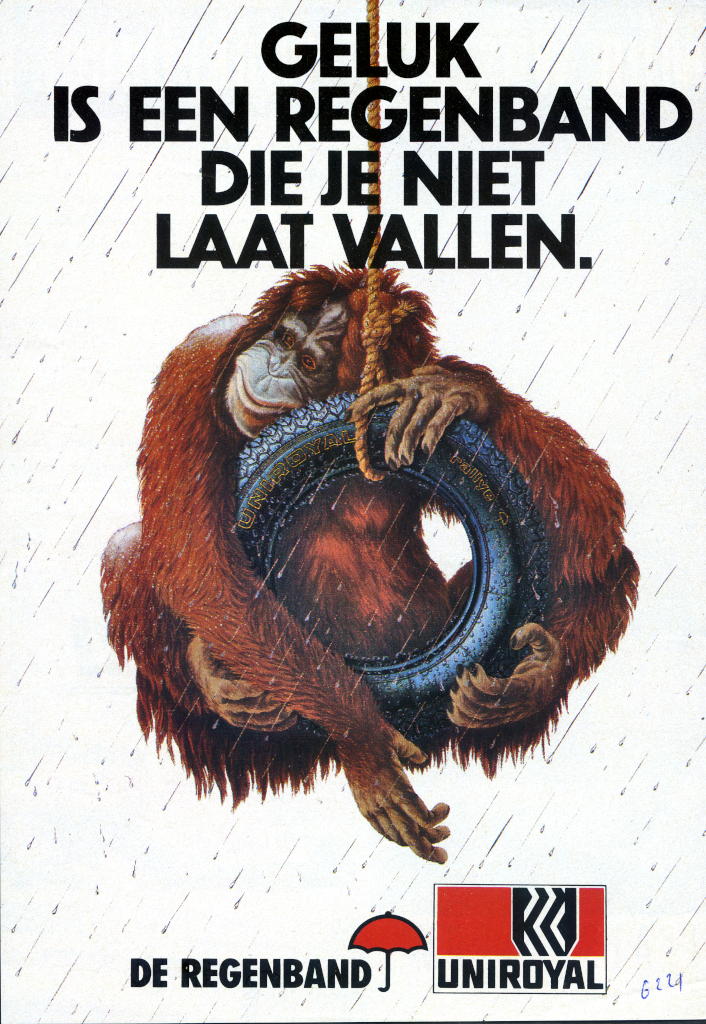
(17) ???? – Happiness is a rain tire you can trust — rain tire.
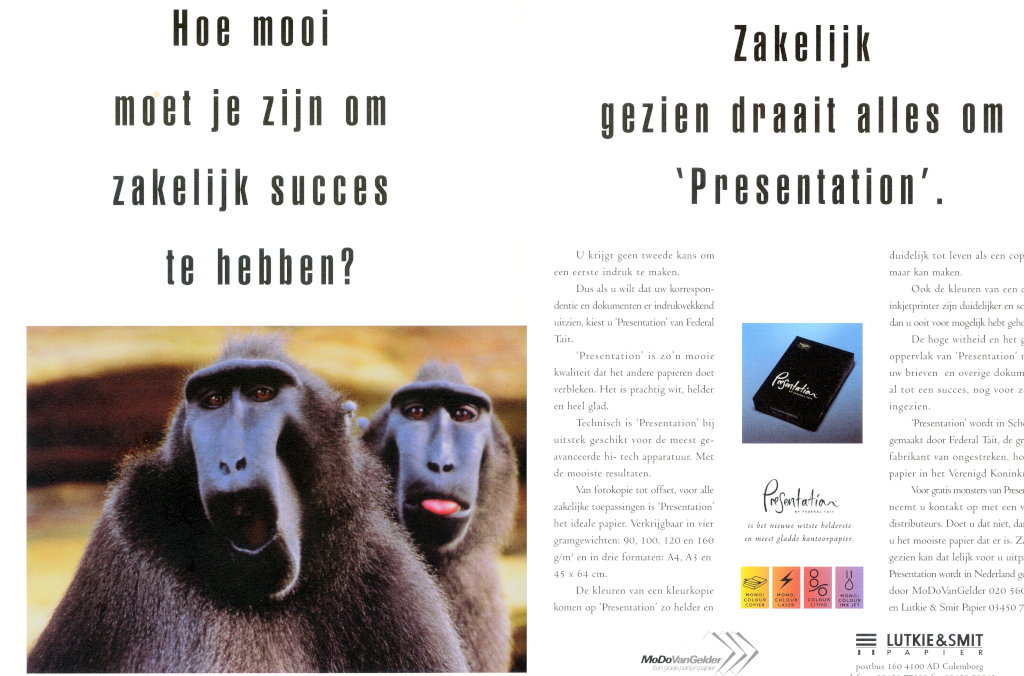
(18) 1995 – How beautiful is required for business success? — paper for printing.

From time to time, other apes
also appear in an advertisement. But unfortunately, just like with the gorilla, their casting has little to do with the characteristics of the species used.

The advertisement for the rain tire (17) could have used any animal species for which the outdoor area in the zoo is enriched with suspended car tires. It does not necessarily have to be an orangutan.

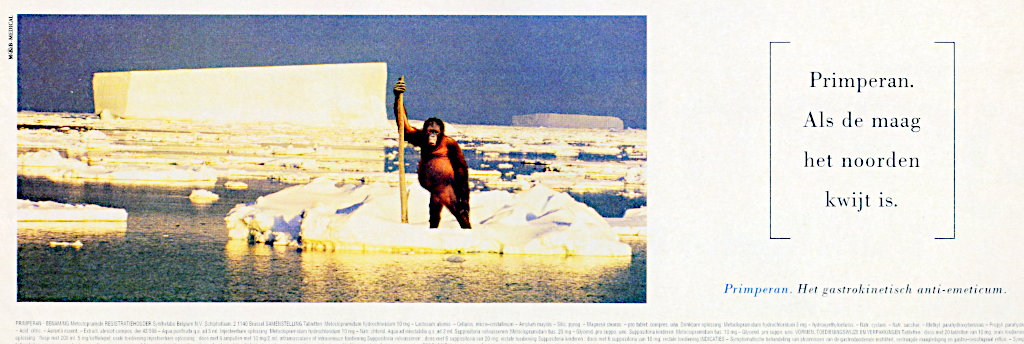
We find the other orangutan (19) far outside its habitat. It is a frequently used recipe: place an animal outside its habitat to illustrate confusion, a contradiction, or a contrast. In any case, the species itself is rarely important. What matters is that the species and the environment do not fit together ¥. In № 19, the image must convey the feeling of being confused. Dutch has an expression for that: het noorden kwijt zijn which literally translates to having lost the North. That explains why a polar landscape was chosen. The animal did not necessarily have to be an orangutan; any species that does not live at the poles would do.

(19) 1997 – When your stomach has lost its bearings — anti-emeticum.
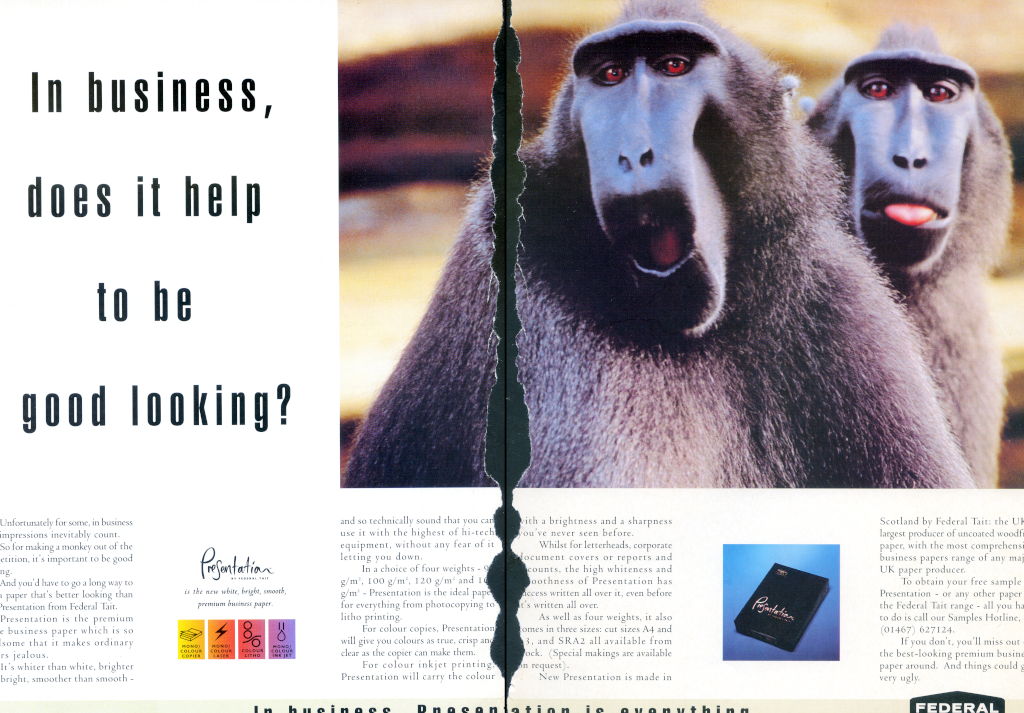
(20) 1995 – Do good looks help in business? — paper for printing

In business, does it help to be good looking?
are we asked in №s 18 & 20. The exam­ples are part of a series of adverts for paper for a range of applications in a business environ­ment like copiers, inkjet printers, offset printing, etc.

Early in the rather long text (20) we find … So for making a monkey out of the competition, it's important to be good looking. … Which means that we have to use this paper in order to make the others look foolish or ridiculous. The Dutch version (18) puts it more kindly and also more positively with So if you want your correspondence and documents to look impressive, choose …. No monkey is mentioned in № 18, which confirms that any random animal species () could have been chosen, provided its appearance matched the requirements (which we do not know). And therefore the question remains whether the depicted animal (§) is an example of good looking or the opposite.

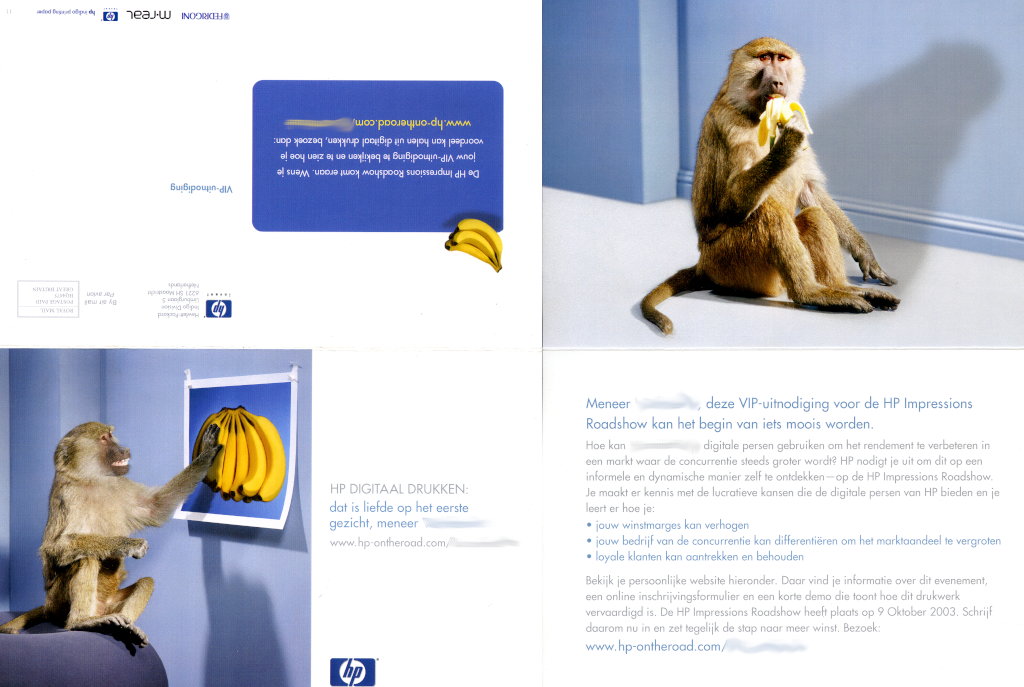
(21) 2003 – Love at first sight — digital printing.
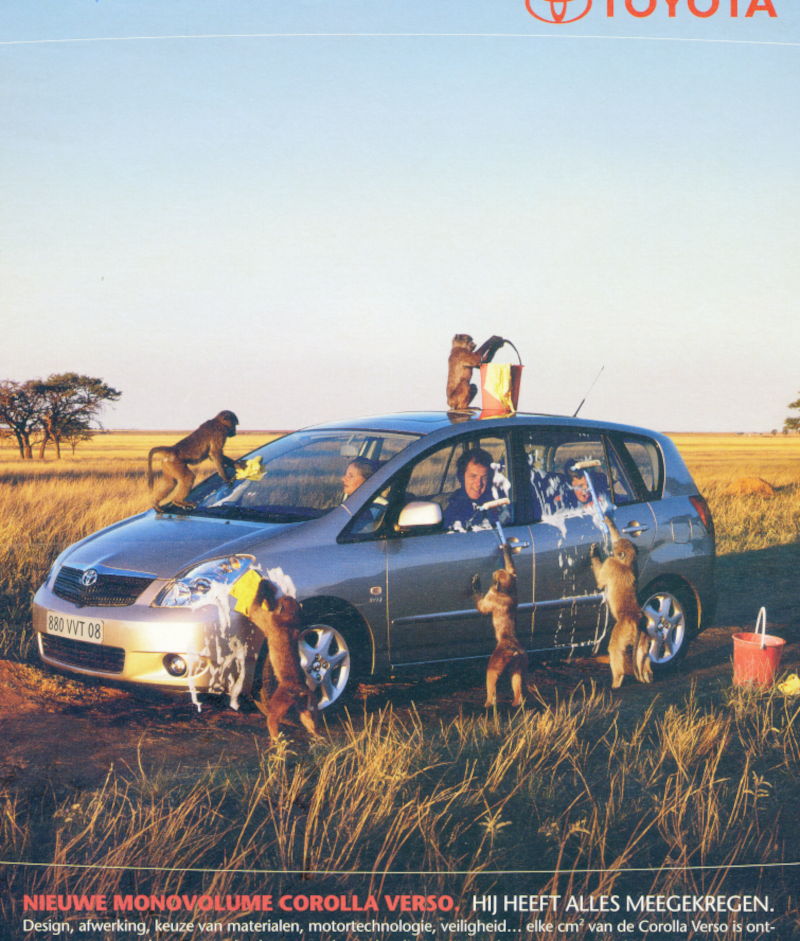
(22) 2002 – He was given everything — family car.

Monkeys are crazy about bananas,
we have learned earlier in № 5. Here we are told: this baboon and the banana, that is love at first sight. Digital printing is of such realistic quality that the poor animal is completely deceived. This approach, of coupling a species with its favourite snack, is often used to sell Good image quality: f.e. Cat with Mouse, Cat with Fish, Mouse with cheese — see [Illustration 5 – True Colour]. Consequently, there was no strong reason to choose a baboon; other species would also do the job.

The family car of № 22 has everything. Design, finish, material selection, engine technology, safety … The car is shown in a savannah setting and is washed by a group of baboons. Baboons may well survive in the savannah, but why does that car need to be cleaned? By monkeys? To suggest adventure? Like a safari in the city-jungle?

Finally:

I have added the following two examples only for completeness, as advertisements that focus on the depicted species itself are not discussed (see Introduction).

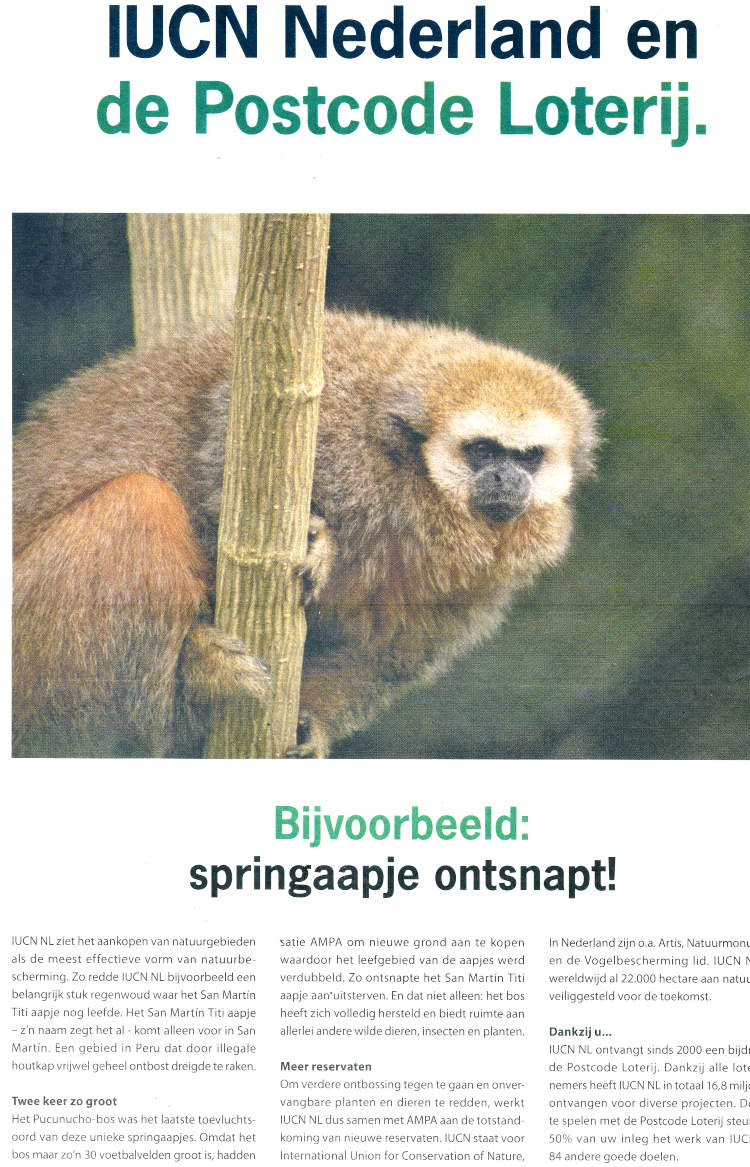
№ 23: the proceeds from the lottery will be used for the purchase of rainforest as a habitat for the Titi Monkey.

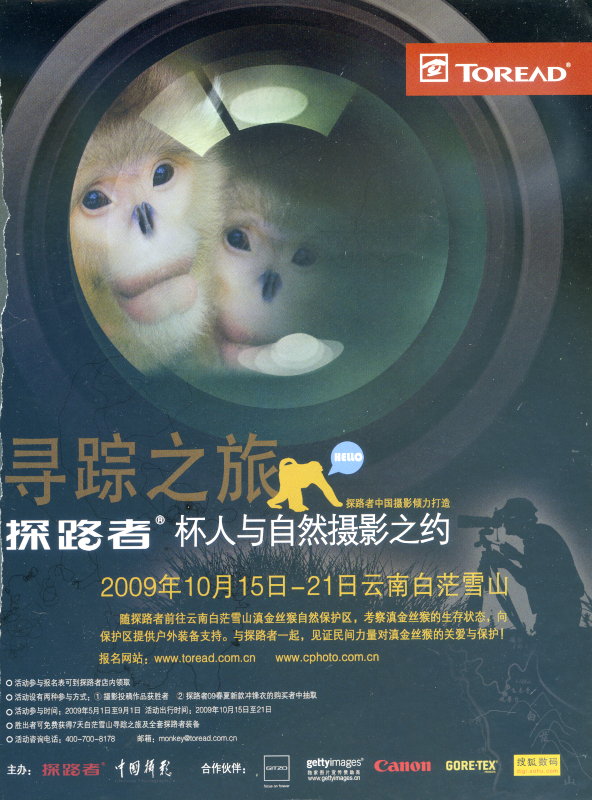
№ 24: winners of the contest will participate in a trip to the Yunnan Golden Monkey Nature Reserve in Baimang Snow Mountain.
(23) 2012 – Titi Monkey escaped — lottery.
(24) 2009 – A Photographic Rendezvous with Nature — photo contest.

 Aap in Dutch = Monkey in English and Mensaap (D) = Ape (E)
 A report about the UHD Zoo exhibition in Seoul can be found at news.samsung.com/global/uhd-zoo-bringing-safari-to-the-city (latest check: 18.vi.2026)
¥ We have examples of this approach with Bear, Giraffe (travel agencies), Camel (consultancy), Penguin (printing paper).
 Other species in this series are: Hippopotamus, Toad, and Colorful fish.
§ The species shown is a Crested macaque which is critically endangered. Find out more at the website selamatkanyaki.ngo: the research, conservation and education programme focused on protecting the Sulawesi crested black macaques and their habitat. (latest check: 20.vi.2026)

Home / Animals in advertising / Primates: apes, monkeys