Animals in advertising – Arachnids
Arachnids are a rare sight in advertising. In over forty years, we've encountered fewer than 10 spiders and only a single scorpion.

They offer little that appeals to the copywriter: spiders spin a web, scorpions inject us with venom, and both instill fear in many people. Difficult to use as a selling point.

But still, sometimes spiders are allowed to join in.

© 
first published: iii.2026

Let's start with
advertisements that refer to spider webs, something we typically associate with this kind of animals, even though not all of them catch their prey that way. I thought that such pictures (1, 2, 4) would make the writers reach for the popular tune of We learned from Mother Nature (). But they did not.

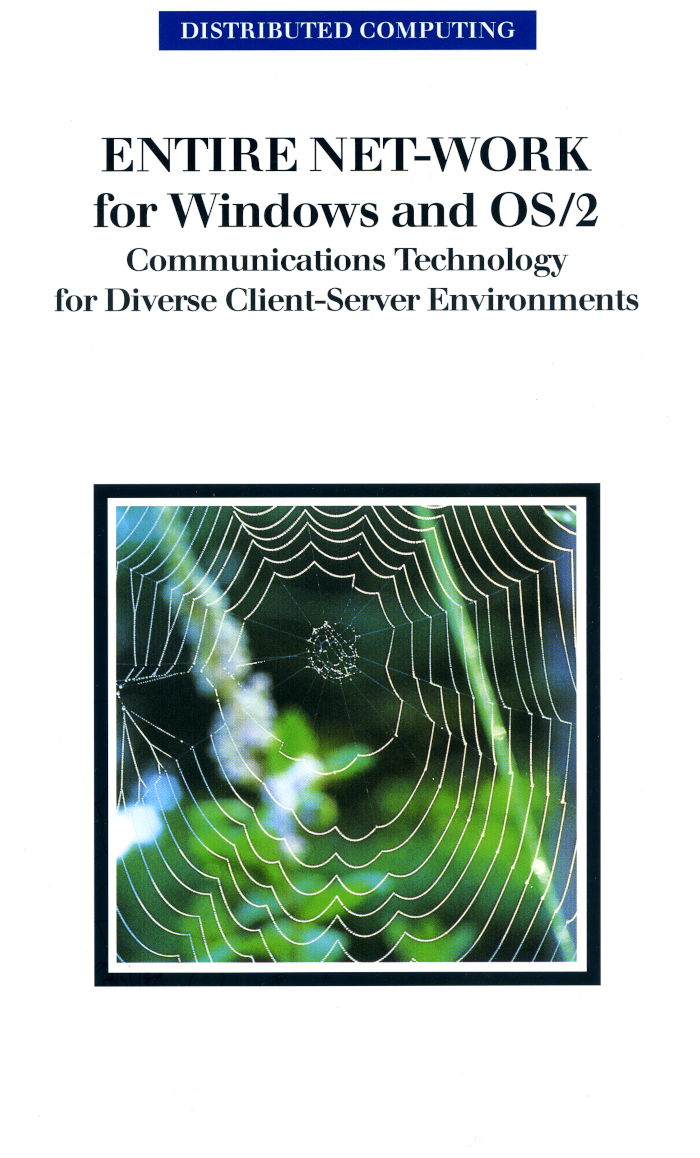
In advertisement № 1 the text at the top goes (from Dutch) We admit, we didn't invent the network. and then the body text continues It doesn't matter where you are within the network. Nothing escapes you. … Faster than the speed of light, you travel to the furthest corner. … They didn't copy, or learn, from the spider, but they did see the analogy of how their product works with a spider that registers every vibration somewhere in its web and then quickly dives to the source to catch its prey. Except for the faster than light claim, of course.

The other supplier (2) simply provides an image of a spider's web, nothing more. The four-page explanation doesn't mention anything else about the spider. It's up to the reader to make the connection.
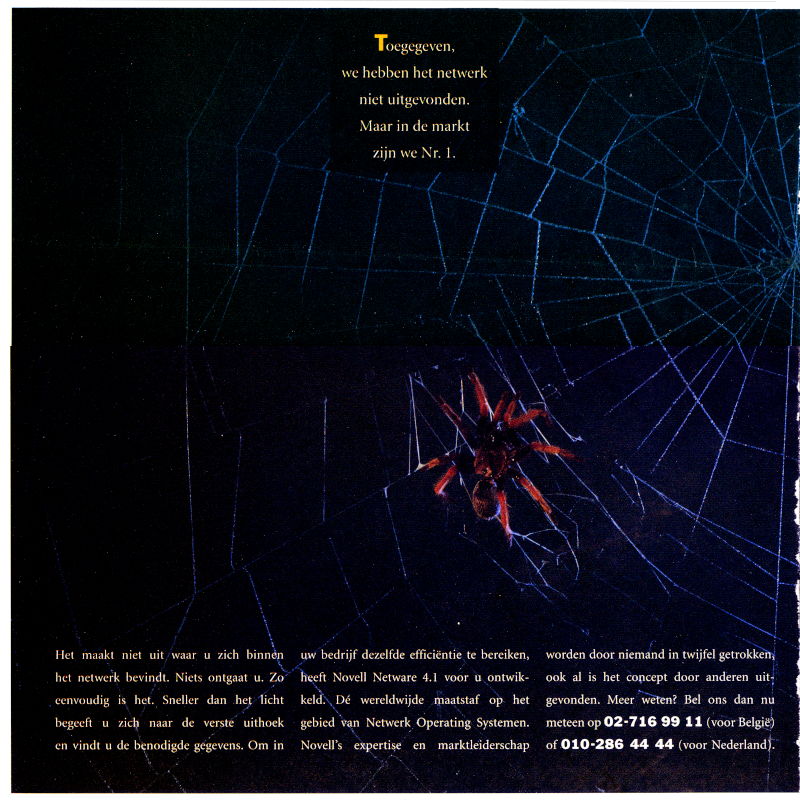
(1) 1996 – Okay, we didn't invent the network — Network management.
(2) 1993 – Communications technology— Network management.
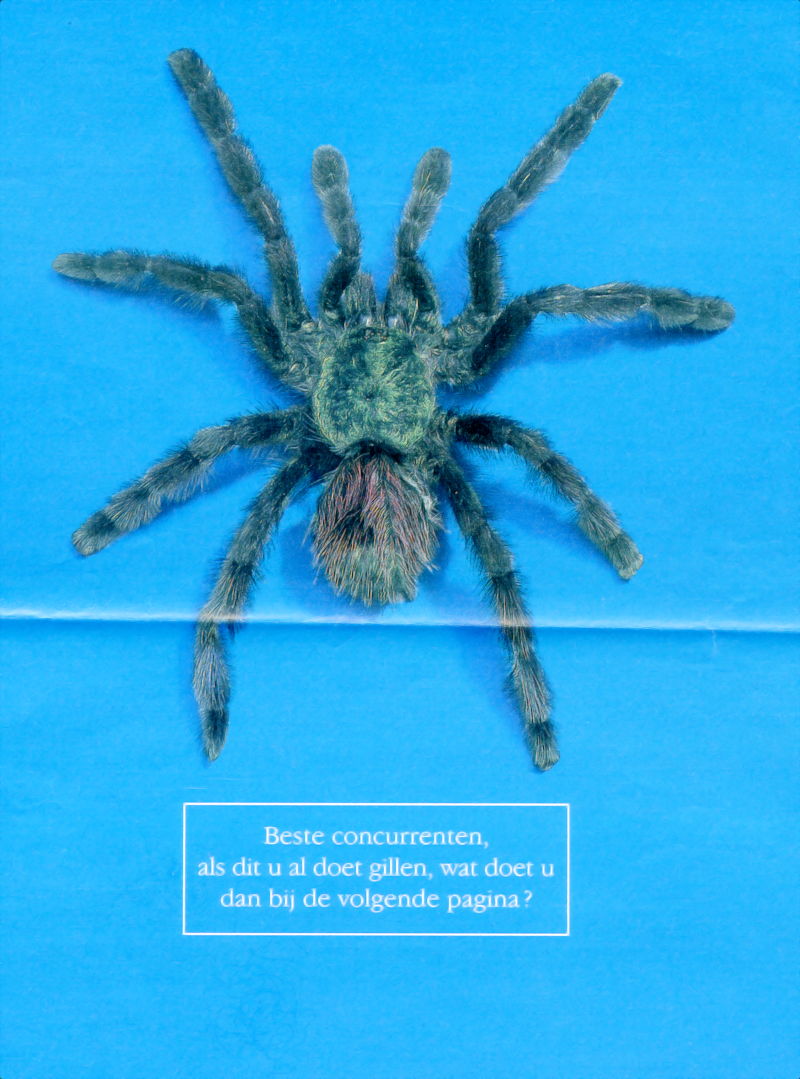
(3) 2000 – If this makes you scream… — car financing.

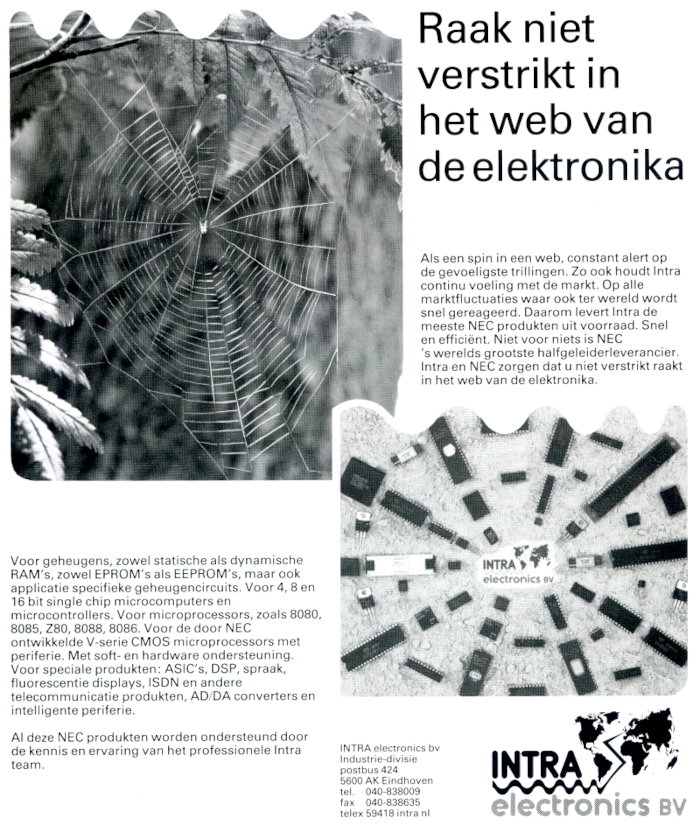
Don't get caught in the web of electronics warns № 4 by a supplier of computer compo­nents. Here we have both an analogy and a warning. Just like a spider in a web, constantly alert to the most sensitive vibrations, the company maintain[s] continuous contact with the market. The ever-changing offering threatens to confuse you, but we will make sure that you do not get tangled up, they repeat at the end. Being nitpickers, we should add here that in reality, prey does not get entangled in a spider's web, but sticks to it.

Spiders instill fear in many people.
This was the inspiration for our next examples (3, 5). They are 7 years apart, they are for different products, and remarkably, they add an identical pinch of humor. The first advertisement (3) is for car financing and is interesting because it initially addresses the competing supplier and not the potential customer: Dear competitors, if this already makes you scream, what will you do on the next page? On the next page we find the excellent conditions which, it is claimed, cannot be matched. So we have fear of the spider and real horror at the offer.

(4) 1988 – Don't get caught in the web
semiconductors.
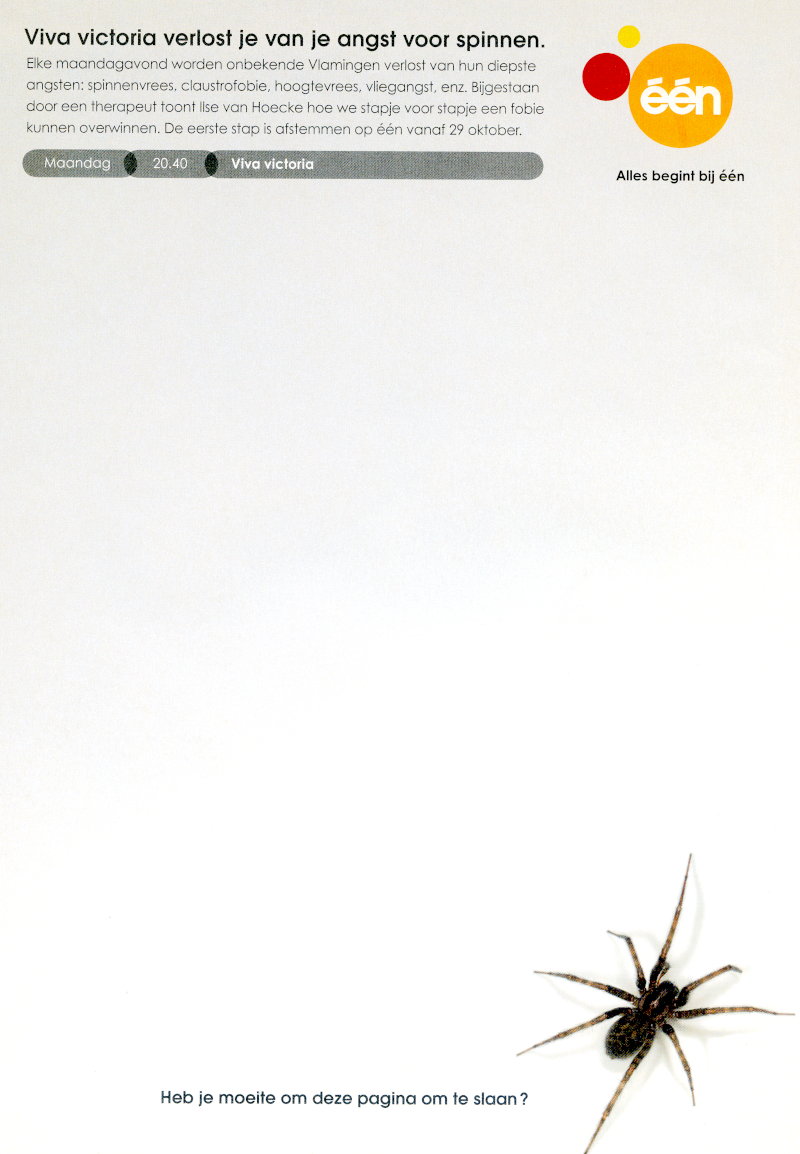
(5) 2007 – Freed from your fears — television program.

Advertisement № 5 is for a television program about irrational fears. At the bottom of the page, where you would grab to go to the next page, it says Having trouble turning this page? Where in the previous example (3) the spider was merely a minor fear compared to the conditions, the spider here is the real source of fear.

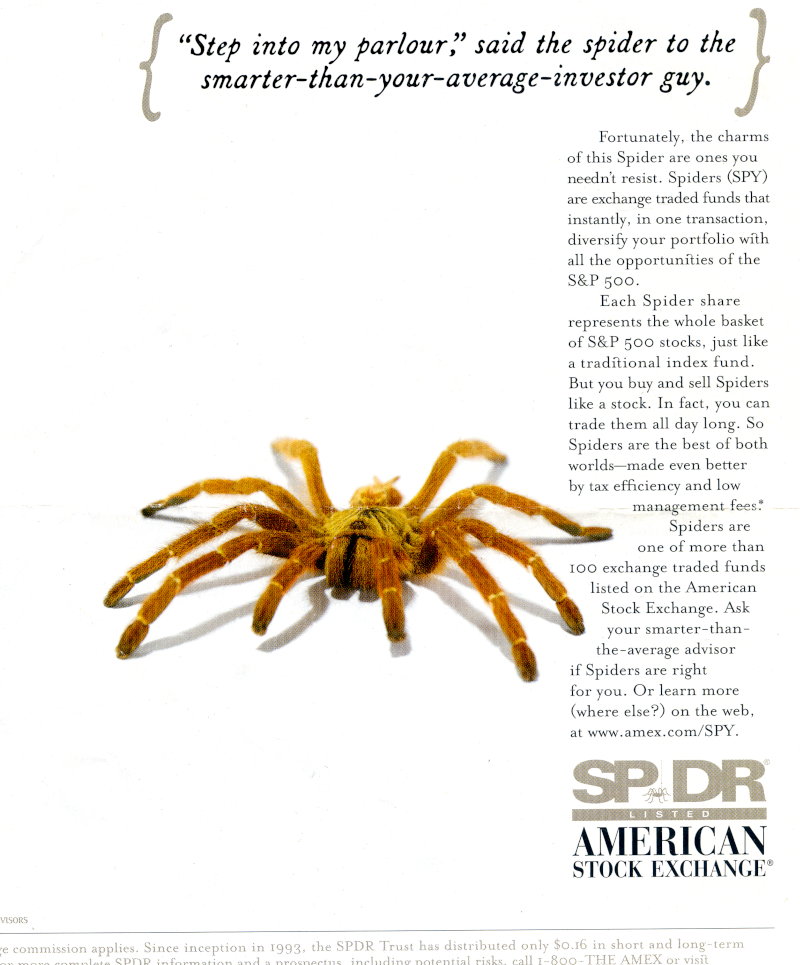
(6) 2003 – No need to resist the charms of this spider — exchange traded funds.
The charms of this Spider
are the ones you needn't resist., says this advert (6). It is about exchange traded funds called Spiders, or SPDRs, an acronym for Standard & Poor's Depositary Receipts. The reasoning is clear. The acronym sounds like spider, so we show a spider, but to be absolutely sure, we will clearly state that there is no reason to be afraid in this case.

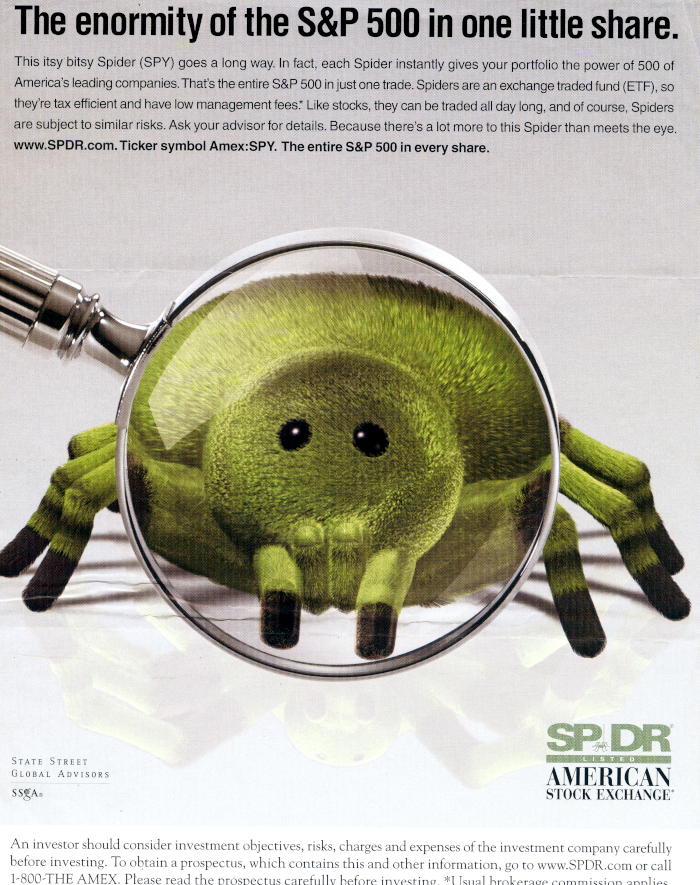
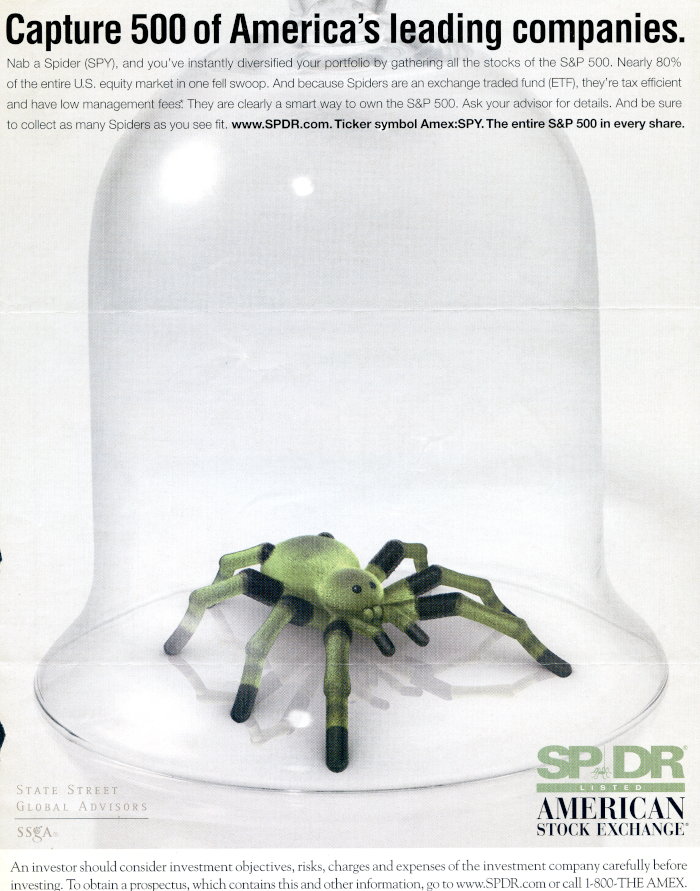
It is noteworthy that later adverts for the same product (7, 8) no longer show a real spider, but make do with a plush one.

All three examples also include an attempt to make us smile. Charms of the spider (6), This itsy bitsy spider with a magnifier glass (7), and Nab a spider with a spider trapped under a bell jar (8). Did they perhaps after the first advert came to the conclusion that a real spider would still scare the reader too much? Maybe they thought the humor wouldn't work with a real spider? Or was it too difficult to organize the composition with a real spider? Who will tell?

(7) 2005 – More than meets the eye — exchange traded funds.
(8) 2005 – Capture the leading companies— exchange traded funds.

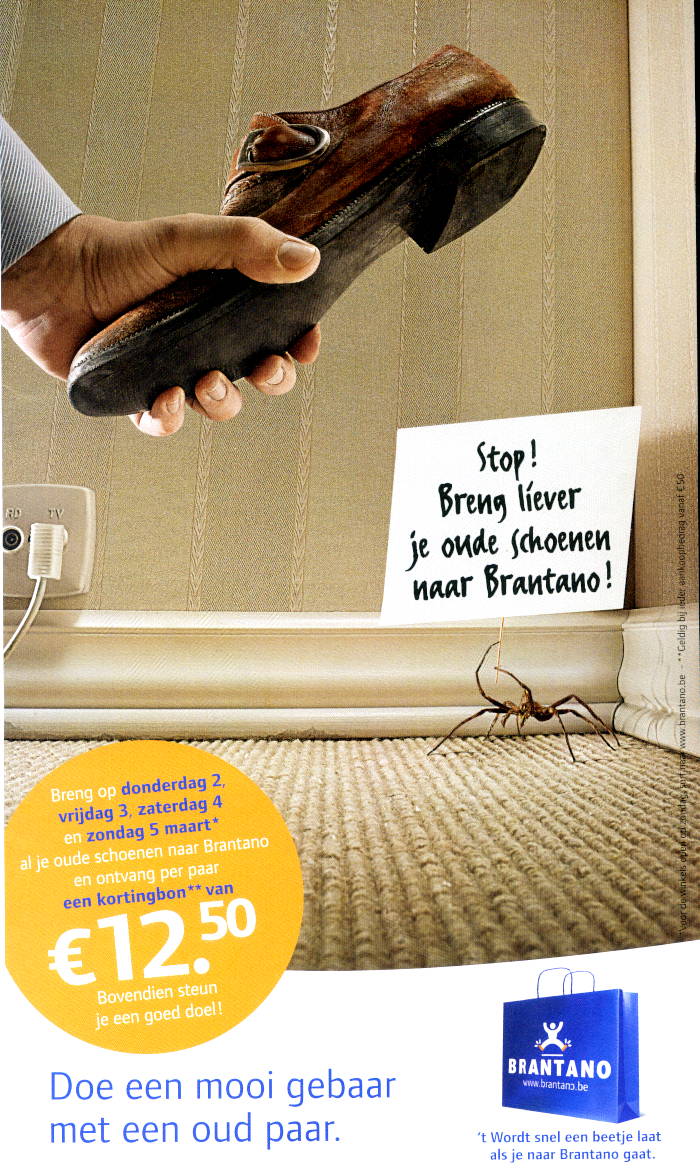
Our last example with a spider
also dares to make a little joke. № 9 alludes to a common reaction when people discover a spider in their home: squash it. The advert teaches us that returning an old pair of shoes will earn us a discount coupon. So don't squash the spider, instead bring the shoe in. Although the first action doesn't exclude the second.

(9) 2006 – Don't kill the spider —
Shoe recycling.
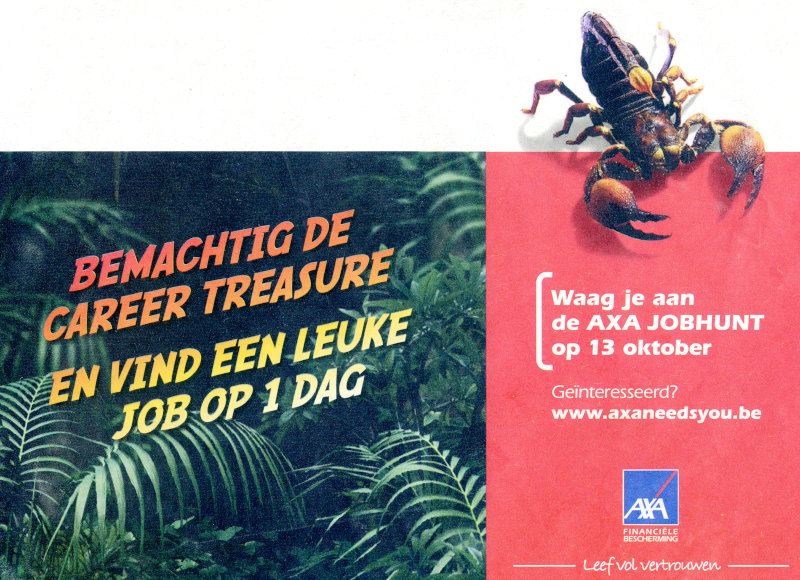
(10) 2007 – Get the career treasure — Job hunt event.

Dare to go on the job hunt
(10) is the only time we have seen a scorpion called upon. We don't see why, however. Perhaps to evoke an adventurous atmosphere? After all, it is a kind of treasure hunt: Get the Career Treasure. It probably won't be an indication of the working atmosphere in that company. Another advert for the same event features a millipede.

Afterword:
Spiders have limited acting abilities. They are only allowed to, or can only, instill fear. Writers then try to mitigate this with a bit of cautious humor. Their web, on the other hand, does not scare anyone and is considered a good analogy for computer networks or other complicated situations.

 We have heard this Learned-from-Mother-Nature tune with many kinds of animals: Cats, Chameleons, Dolphins, Hedgehogs, Penguins, Polar bears, and more.

Home / Animals in advertising / Arachnids: spiders, scorpions