Mills in Altoaragón – harinero, central eléctrica

Gabasa – mills of Fuster
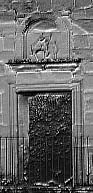
Gabasa is situated east of Barbastro and Monzón. From each location you can easily reach Azanúy, then Peralta de la Sal and then Gabasa. Leave your vehicle at the entrance of the village (near the bus stop) and walk the main street down (arrows to the Barranco de Gabasa). You will pass the church dedicated to Saint Martín, the patron saint of millers in many places. When you get down, walk in the direction of the bridge and look out for an interruption in the street edge. That is the beginning of a narrow and irregular path that leads into the ravine and ends at the Molino de Madart (1).

Pictures: 27.v.2023
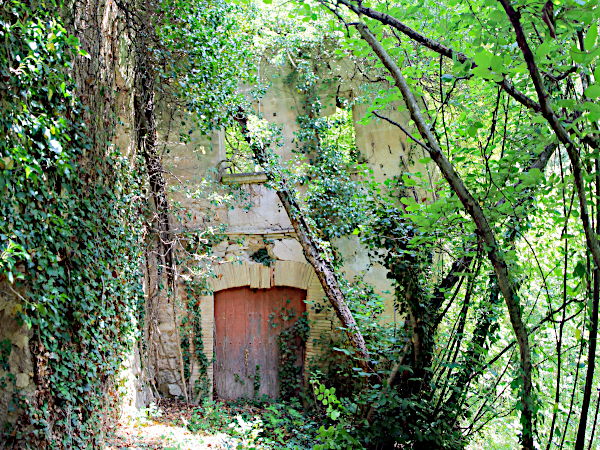
 

Molino de Madart

(1) Façade of the molino de Madart.

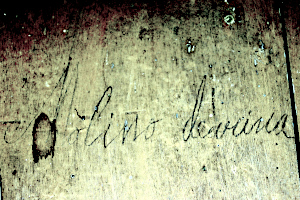
(2) Text on the door: Molino dearina
The building is an empty skeleton and the facade (1), with a few scattered old insulators, is on the verge of collapse. Various things have been drawn and written in pencil on the entrance door, but we can only decipher the text Molino dearina (2). The wall at the back has collapsed, giving us access to the mill room, which is quite large.

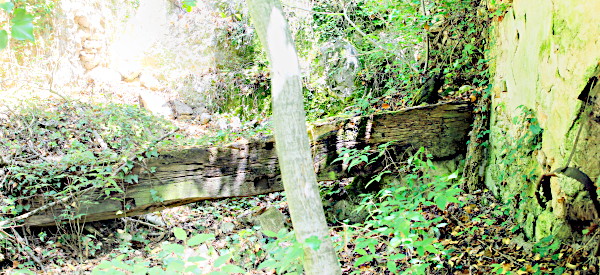
The beam of the bancada is still visible above the rubble (3). Its length suggests that there was room for two pairs of millstones. In the cárcavo, however, there is only space for one wheel (rodete, 4).

(3) Remains of the bancada.

One rodete can drive two millstones via gears and, by means of ribbons, also a grain cleaner and a flour sifter. We are not certain that this was the case here. However, in a side wall of the sala de moler, we find the end of a second pressure pipe (saetín; 6, 3 at right)). Did that pipe supply water to drive supporting equipment with a small turbine?
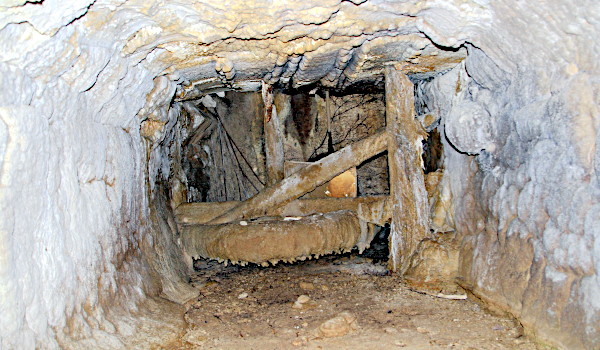
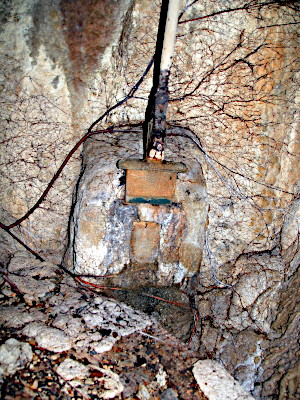
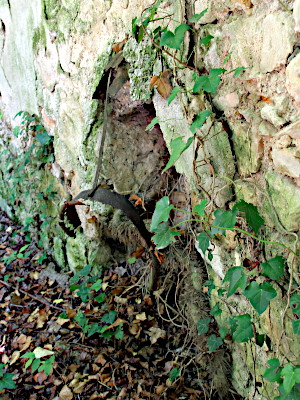
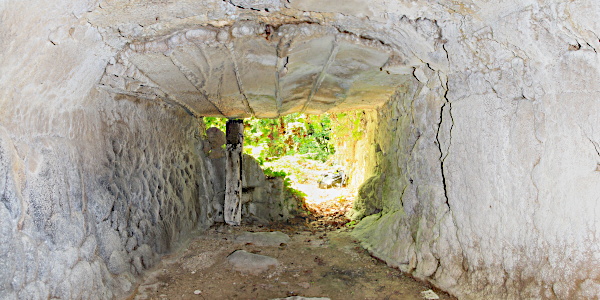
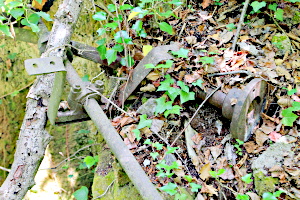
The cárcavo (4) and its contents have survived time better than anything else. Deep at the back of a tunnel with a concrete roof (7), we find one wheel on its metal axle (the top of which is visible among the vegetation in the work place) and a botana (5) with its tajadera. Everything is covered with a thick layer of lime and is therefore well preserved.

(4) The waterhouse with wheel covered in a thick lime crust.

(5) Botana: end of the pressure pipe.
(6) A second pressure pipe in the workplace.

(7) Cárcavo (waterhouse) seen from the wheel.

This flour mill was closed by order of the Servicio Nacional del Trigo (National Wheat Service) in 1940 (as were many others in the province).


Central eléctrica de Fuster

As a complement to the flour mill, but independent of it, the Fuster family had installed a small hydro­electric power plant. This plant had a capacity of four kilowatts and supplied electricity for the Fuster's installations and also the public and private lighting of Gabasa. The central was inaugurated in October of 1920. It stayed in operation until the middle of the 20th century ().
In Nueva España of july 16th, 1958 following text appeared: … La jornada de ayer se inicio en Gabasa, donde se puso en funcionamiento el nuevo alumbrado eléctrico. Recibieron a las jerarquías el alcalde, camarada Vicente Fuster; … Primero se procedió a la bendición del transformado …

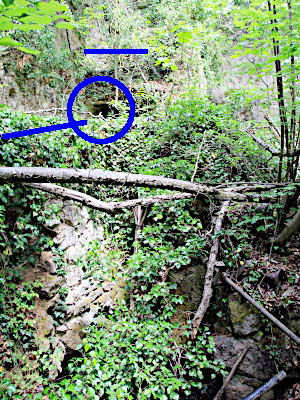
(8) The central eléctrica below the mill.
horizontal line: workfloor of flour mill;
circle: mouth of cárcavo;
slanted line: restitution channel
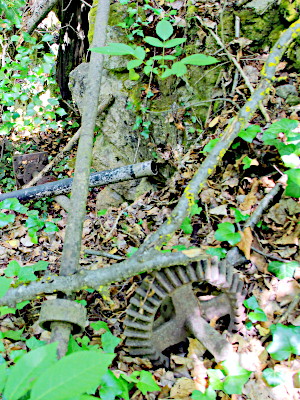
(9) Gear remaining from the central.

(10) Gear remaining from the central.
Translation: …Yesterday's events began in Gabasa, where the new electric lighting was inaugurated. The mayor, Comrade Vicente Fuster, received the digni­taries; … First, the transformer was blessed …

The power plant (lower half in 8) is located one level below the grain mill and has its own independent water supply. In the pit where the power plant was, we can still see shafts and gears and other pieces of metal (9, 10), and a turbine may possibly be hidden under the rubble.
The power plant also has its own closed restitution channel that flows into the river. Currently, only the top of the arch is still visible in the riverbank; the rest has silted up and is hidden under a thick layer of litter.


The waterworks

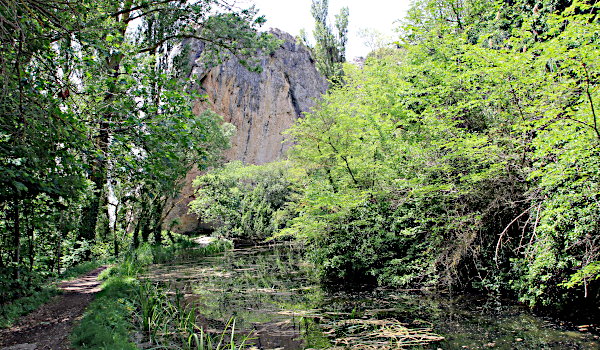
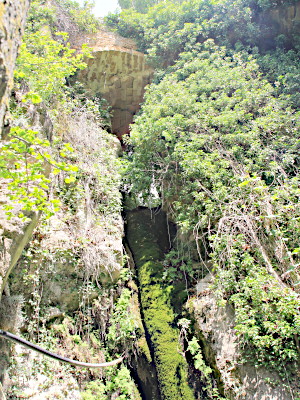
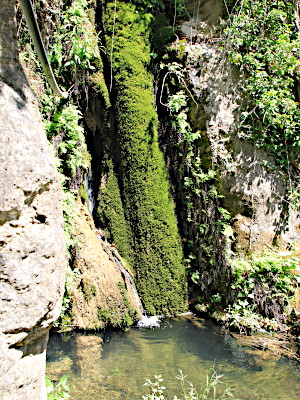
The mill pond (11) for both mills is located in the upper section of the river (upstream from the bridge). From there, first through a small tunnel drilled into the rock face, and then a drop of more than 10 meters (12-13), the water reached the wheel.

(11) The mill pond.

(12-13) Pressure pipe coming down from the pond.


 Baringo Jordán, Ernesto — 2018 — Molino hidráulicos: los antiguos molinos del Río Sosa —
Monzón; Cuadernos del CEHIMO №44; pp. 249-293; ISSN: 1133-3790
The section about the mills of Gabasa is at pages 262–266.
 Vanhercke L. & Anselin A. — 2023 — A la búsqueda de molinos. A Gabasa y el río Sosa —
el Gurrión viii.2023, № 172, p46-49; ISSN: 1130-4960 — Download PDF

Path: Home / Altoaragón: old mills / Gabasa
Introduction
Learn about the parts of a mill
Visit the mills; catalogue
Literature and websites
© and e-mail: