Mills in Altoaragón - harinero
Olsón
Olsón can be reached from
the main road between
L'Ainsa and
Barbastro turn to
Lamata in
Mesón
de Ligüerre de Cinca. Follow the road for quite some time
and turn right just before Olsón where Mondot is signposted.
The road goes down the bridge. Walk with the stream from the bridge until you find a track
uphill and at a certain distance parallel with the river.
After some time you'll pass next to the
Fuen Calién (
†). Now you can
a) work your way to the river and follow the bank until you reach the mill,
or b) stick to the road which will bring you to the river-bed and the mill eventually.
The mill is know as the
Molino (de) López.
Pictures: 03.i.2002, 06.v.2022
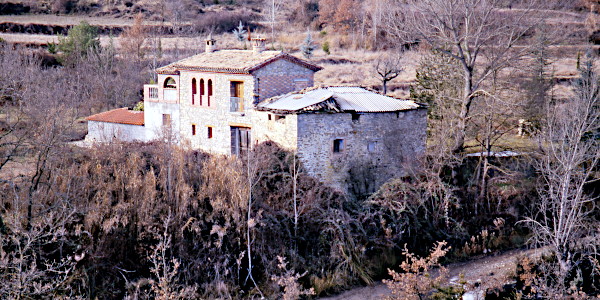
The mill is part of a much larger complex that has all the characteristics of a second home.
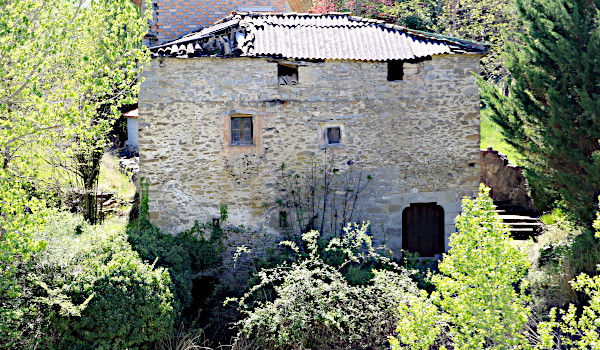
The actual mill is the section with the corrugated iron roof, closest to the river (1, 2).
It's crystal clear that the owners don't care much for the mill. While the living quarters look well-maintained, the mill itself exudes neglect.
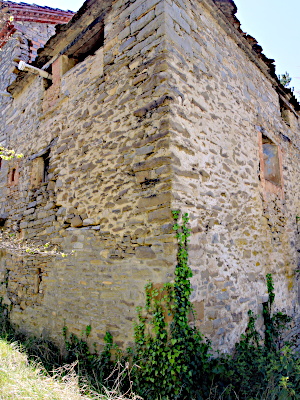
The roof and walls are in particularly poor condition (2, 5).
In the 20 years between our visits, no significant improvements have been made.
Only a few sections of the walls have been repointed with grey mortar: to the left of the entrance (compare 3 with 2) and the southeast-facing corner (5).
Emergency repairs without taking into account the original color of the joints?
The front facade shows a number of irregularly distributed openings,
of which the lower ones interest us most: on the left (2) a small window above each of the wheelhouses (cárcavos) and on the right the large entrance door.
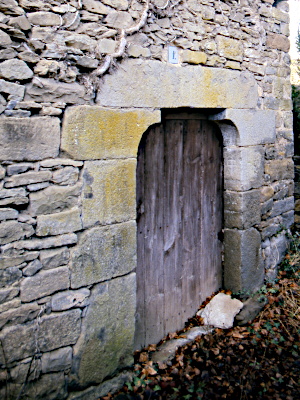
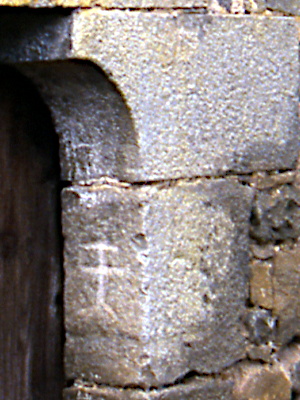
As in many other mills, the doorposts here also show some protective signs, of which the double cross (4) is the most obvious.
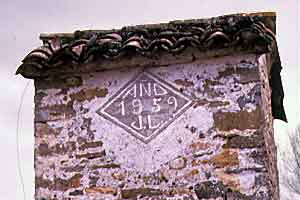
Some of the stones also appear to have text engraved on them, but nothing is clear enough to determine whether and what exactly is written.
Everything was well locked up and there was no one on site, so we don't know if any equipment from the previous activities has been preserved inside.
A walk around the immediate area yielded no results.
We couldn't determine where the canal was, nor the mill pond.
However,
S. Pallaruelo (
‡) mentions the presence of a mill pond and pressure pit,
similar to those that can be seen in the
mill of Ara, and with two pipes that led to the wheels.
I assume that the mill pond disappeared during the construction or renovation of the current residence.
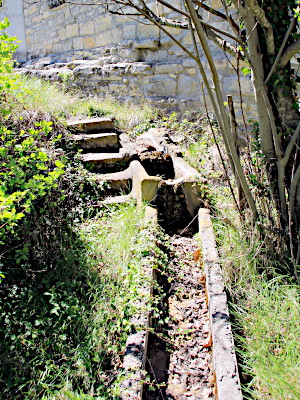
A gutter running along the building (6) may be a remnant of the water system.
I don't think the water for the mill came from the river.
I see two possible sources. One is the Fuen Calién, the other is the small rivulet coming
from the hill behind the mill. There probably never was an abundance of water.
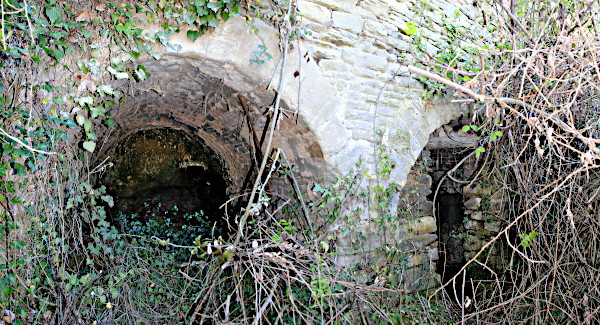
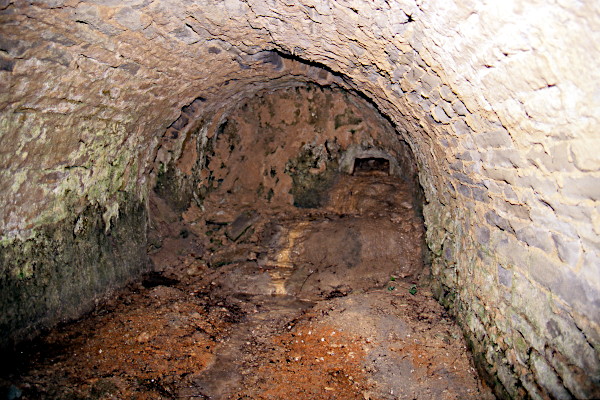
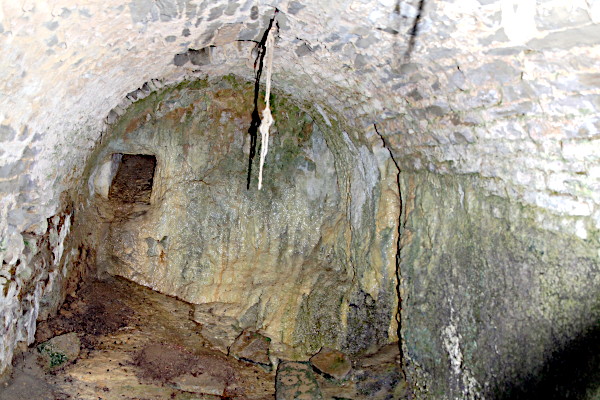
Two wheel houses (7, cárcavos), each with a small
window above (2), discharge directly into the river across the gravel road. They are both empty (8, 9) but the masonry is still
in good condition.
The cárcavo left (8) is wide open.
The other cárcavo (9) is closed with brickwork and a door (7) and may have
served as a cellar.
† Read more about the Fuen Calién in
Pablo Saz Peiró
— 1992— Fuentes minero-medicinales de la provincia de Huesca.
Ed. Instituto de Estudios Altoaragoneses (Diputación de Huesca). I.S.B.N. 84-86856-74-4
‡ Pallaruelo Campo, Severino – 1994 –
Los Molinos del Altoaragón.
Instituto de Estudios Altoaragoneses (Diputación de Huesca). ISBN: 84-8127-013-X