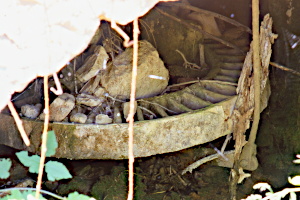
Mills in Alto Aragón - harinero, central eléctrica

Nocito
Nocito definitely is a nice spot. And remote.
1) From Sabiñánigo drive south to Huesca until you reach Lanave. Turn left where Boltaña is signposted. Don't miss the branch towards Nocito.
2) From Boltaña cross the Río Ara and follow directions for Lanave. It will take some time but eventually you will reach the Molino de Villobas. Now look for the Nocito branch to the left.

From here on it is still 12 km of narrow road more. Park your vehicle near the crossroads where Bara is signposted. Walk the short stretch in order to visit first the site of the former azud on the Río Guatizalema.

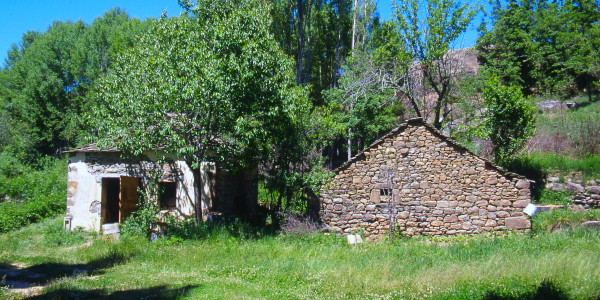
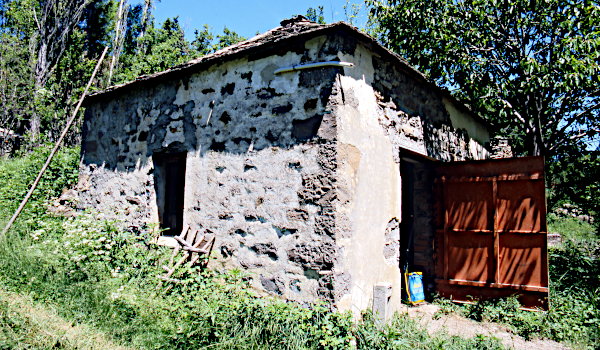
(1) Central eléctrica (left) and the flour mill (right).


Water works

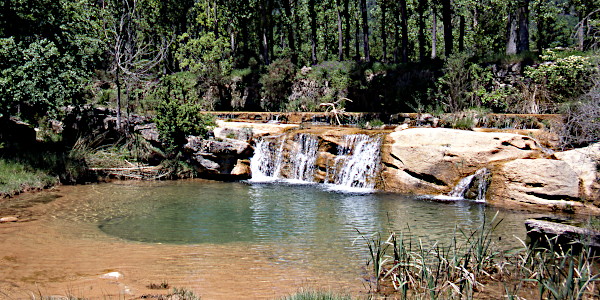
(2) The place of the dam on the Río Guatizalema.

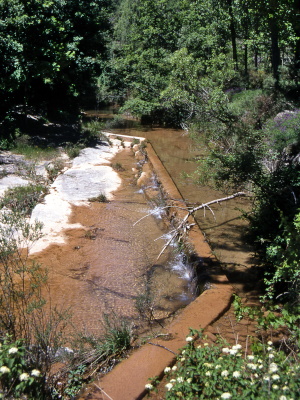
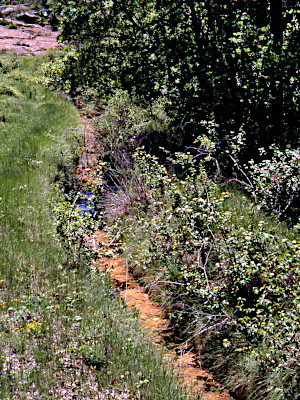
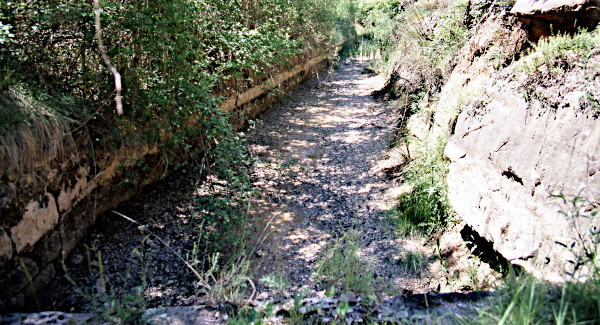
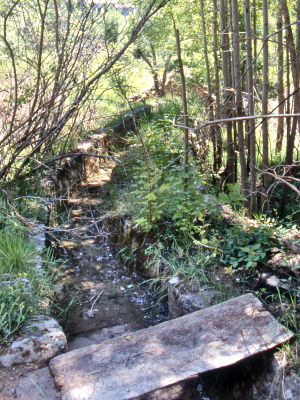
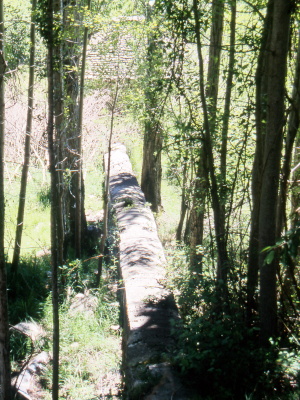
Both mills share most of the water works. The water is tapped from the Río Guatizalema at a point north of the village (2, 3). From this azud a wide canal (4) on the left bank of the river carries the water towards a reservoir (6) which towers high above both mills.
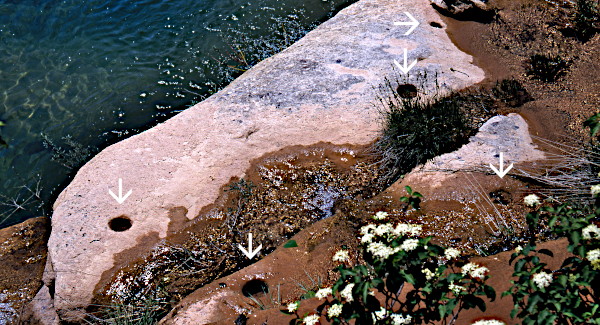
In the stone slabs of the riverbed, several rows of round holes can be seen (5). These are the footprints of former dams that were built with horizontal wooden beams, attached to wooden poles which in turn were supported by slanted posts.

(3) The dam on the Río Guatizalema.
(4) The canal which brings the water to the mill pond.

(5) Foot prints of former wooden dams.

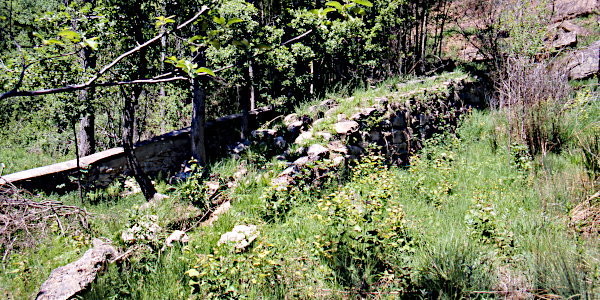
The mill pond (6) makes optimal use of the site's layout. On the north side, the edge of a rock bank (right in 6) serves as a boundary. The east and south walls consist of carefully constructed masonry walls approximately one meter thick. The mill pond forms a long triangle that is widest at the east side and gradually narrows towards the junction with the canal (top in 6) on the west side.
At the foot of the rock bank are the mills (1), each with its own supply channel. The open chute (7) for the flour mill starts in the east wall, is built with natural stone, and makes a wide curve (8) before running down. The closed pressure pipe for the power station comes straight down from the southwall (7, 9).

(6) The mill pond, making optimal use of the terrain.

(7) Left: closed conduit for the central; right: the open chute of the flour mill.

(8) The open chute for the flour mill.
(9) The closed pressure tube for the central eléctrica.


Central eléctrica

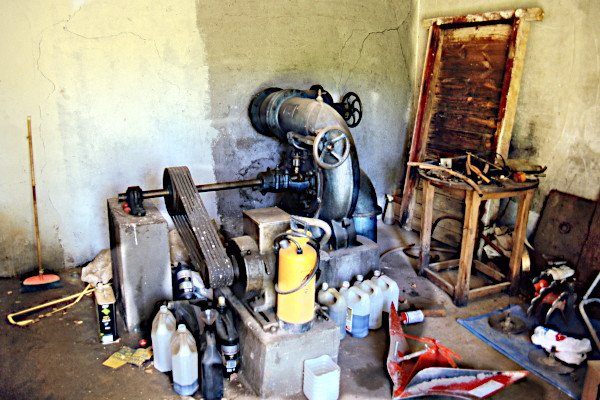
(10) The central eléctrica.

The power was turned on for the first time in March 1926 . People dragged the turbine 12 km from the Molino de Villobas. The powerstation was the property of a society of most of Nocito's inhabitants. The network was limited to Nocito and the santuario de San Úrbez nearby.

This old generator produced continuous current (DC).

The installation was shut down in April 1960 when the number of inhabitants dropped below the critical minimum to continue the maintenance of the turbine.

In 1972 the village council decided to install entirely new power generating equipment at the same place and the first alter­nating current (AC) left the building on Christmas of that year.

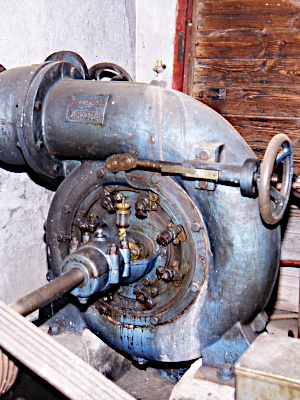
(11) The turbine with what looks like a pump.

(12) Turbine.
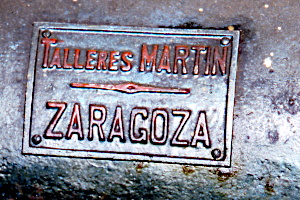
(13) Talleres Martín — Zaragoza.

In the 1990s a diesel generator was placed next to the old equipment. This configuration was meant to address the problems of living in modern times without electricity. However the generator was only turned on at night and still did not allow the use of modern appliances. Eventually Nocito would be connected to the grid in 1999. Some of the other small communities in the region would have to wait for twenty years more.

During our visit we could no longer recognize anything related to the former energy production, apart from the turbine .


Molino harinero

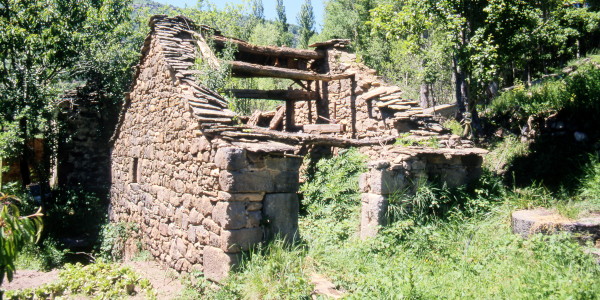
(14) The flour mill; notice the stone at right from the entrance.

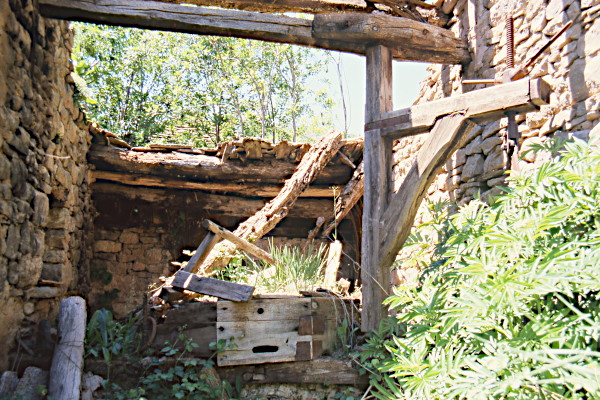
(15) The flour mill; notice the intact crane; octogonal stone case; remains of the cabalete (horse).

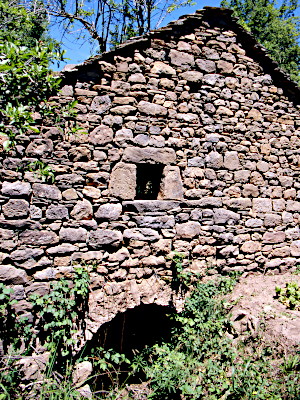
(16) Window overviewing the outflow of the cárcavo.
(17) Iron horizontal wheel.

The flour mill, just like the central eléctrica, is a simple construction consisting of one single space. Inside (15) we recognize the crane with its pinchers, the controlling wheel of the levador and an octangular stone case.

There have been other flour mills in Nocito.
In Cara y Cruz in the section about flour and bread (p62) appears the following text: … El trigo era transportado al molino. Había dos en Nocito, haciéndose molinada a fin de que resultara harina para todo el año. …. This clearly indicates that there used to be a second grain mill.
In Nocito appears the title Tres molinos harineros and A. Castán gives a description of two other mills besides the one we visited here. They were located south of the village, and according to him, some remains can still be found today. We have not seen them yet; one day we must return. It is likely however that at any time only two of the three mills were in business.


 Inmaculada De la Calle Ysern & Ángel M. Morán Viscasillas — 1994 — Cara y Cruz en Nocito. El ayer y el hoy de una comunidad en la Sierra de Guara. Ed. Instituto de Estudios Altoaragoneses (Diputación de Huesca) et al.; ISBN 84-8127-010-5; 126 pp.
 Adolfo Castán Sarasa — 2026 — Nocito in La Sierra de Guara tomo 3. Ed. Pirineo (Huesca); ISBN 979-13-87758-08; pp. 148–154.

Path: Home / Alto Aragón: old mills / Nocito
Introduction
Learn about the parts of a mill
Visit the mills; catalogue
Literature and other websites
© and e-mail: